
 CRM
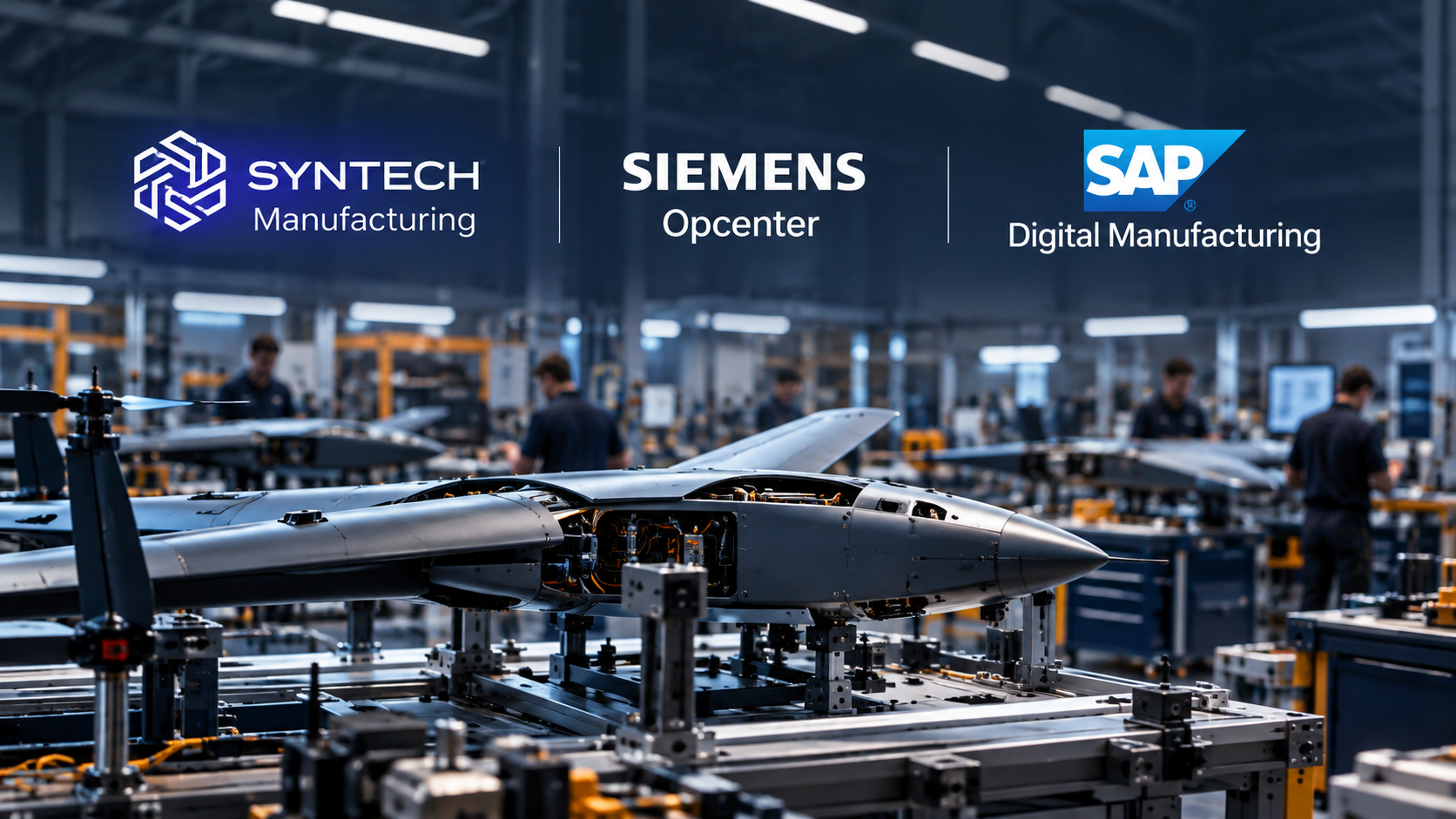
CRMSYNTECH Manufacturing vs Siemens Opcenter vs SAP Digital Manufacturing: MES comparison
Choosing an MES for MilTech manufacturing is not just about comparing feature lists.
Sales & CRM automation
Pipeline, customers, operations and analytics driven by processes, not spreadsheets.
For a manufacturer of UAVs, electronics, components, or other complex products, it's important how the system handles BOMs and revisions, material and capacity planning, serial numbers, traceability, quality control, and the actual execution of shop floor operations.
In this material, we compare three solutions that might make it onto the shortlist for such a project:
SYNTECH Manufacturing, Siemens Opcenter Execution Discrete, and SAP Digital Manufacturing.
These are not three identical products. They differ in architecture, ecosystem, and approach to manufacturing digitalization. Therefore, instead of a conditional ranking, we will analyze them based on real production scenarios.
Briefly about the three systems
SYNTECH Manufacturing
SYNTECH Manufacturing - MES/MRP solution on the Creatio platform for digitizing manufacturing processes.
The system covers production planning, MRP, production orders, operations, material handling, warehouse processes, procurement, quality control, traceability, equipment, and production analytics.
For MilTech, the capabilities for working with BOMs and revisions, batches and serial numbers, material and capacity planning, quality control, and production history are particularly important.
A distinct feature is the Creatio platform. This allows building the production circuit within the same low-code/no-code ecosystem and adapting business processes, permissions, fields, and other system elements to a specific enterprise.
Siemens Opcenter Execution Discrete
Siemens Opcenter Execution Discrete is a Siemens MES for discrete manufacturing and complex assembly processes.
The system is designed, in particular, for productions with large and variable BOM/BOPs, numerous production orders, and dependencies between them. Siemens documents change management, non-conformances, component traceability, and MES interaction with corporate systems. Siemens
For our comparison, it is also important that Siemens separately positions Opcenter Execution Discrete for aerospace & defense, including assembly processes with high complexity and low production volumes.
SAP Digital Manufacturing
SAP Digital Manufacturing is a cloud-based Manufacturing Operations Management platform that connects the enterprise level with the shop floor.
The solution supports discrete, repetitive, process, and service manufacturing, and integrates execution, resource orchestration, manufacturing analytics, quality scenarios, and automation. SAP Digital Manufacturing is deployed on SAP Business Technology Platform. SAP
Therefore, SAP DM is particularly logical to consider for enterprises where SAP is already part of the corporate IT landscape.
Comparison of SYNTECH Manufacturing, Siemens Opcenter, and SAP Digital Manufacturing
1. BOMs, revisions, and changes in manufacturing
For MilTech, this is one of the key scenarios.
The product design can change during the preparation or execution of a production order. One component is replaced by another, a new revision is created, the routing changes — and production must clearly understand which version is used for a specific product.
In SYNTECH Manufacturing, production planning is linked to specifications and routings. The system works with revisions, and MRP uses the product structure to calculate material requirements.
For MilTech, this allows connecting the questions:
what are we producing → according to which specification → what materials are needed → what needs to be purchased → what actually went into production.
In Siemens Opcenter Execution Discrete, working with large and variable BOM/BOPs is one of the stated scenarios. Siemens separately implements change management: an engineering or production change order is linked to the production orders, materials, components, and processes affected by the change.
In SAP Digital Manufacturing, the execution level is closely linked to the corporate SAP ecosystem. Therefore, it should be evaluated not in isolation, but together with how master data, planning, and ERP processes are organized at the enterprise.
What to check during a demo
Don't just ask: “Does the system support BOMs?”
It's better to give the same scenario to all three vendors:
The production order has already been created. An engineer changes one component in the specification. Show how this change will reach production and how the system will maintain the history of which revision was used for a specific product.
Such a test will show the real difference between the systems.
2. MRP, materials, and component shortages
For MilTech, planning is not just about the production calendar.
The system must answer a practical question:
do we have enough materials to meet the plan on time?
In SYNTECH Manufacturing, MRP works with specifications, stock levels, and open deliveries, determines material requirements, and helps generate purchasing needs.
This means the production plan can be linked to the actual material availability.
For UAV production, this is especially important: the absence of one critical component can affect the execution of the entire order.
SAP Digital Manufacturing has a different emphasis. Its Resource Orchestration helps dispatch operations considering resources, the current shop floor situation, priorities, and availability. SAP supports automatic operation distribution and load balancing across available resources.
In the case of Siemens, it's important to distinguish between execution and planning: Opcenter Execution Discrete is primarily an MES for production execution. Therefore, when comparing, you need to look at the required configuration of the Siemens landscape, not automatically equate Execution Discrete with a full-fledged MRP.
This is a fundamental difference: MES execution and MRP are not the same thing.
3. Traceability and serial number tracking
For regular manufacturing, traceability can be a useful feature.
For MilTech, it can be critical.
Imagine a situation: a supplier reported a problem with a specific batch of electronic components.
You need to quickly answer:
in which finished products was this batch used?
And conversely:
which components were used to assemble a specific product with a specific serial number?
In SYNTECH Manufacturing, batches and serial numbers are used, material movement history is maintained, and labeling and codes can be used for identification. This forms the basis for traceability from materials to finished products.
In Siemens Opcenter Execution Discrete, traceability is one of the basic MES scenarios. Siemens explicitly states tracking and tracing of manufactured components. Operator scenarios also support material tracking units, serial numbers, traceability operations, and production history.
SAP Digital Manufacturing provides visibility at the component and material level and links production execution with enterprise and shop-floor systems.
For MilTech, here it's necessary to check not just the presence of traceability, but its depth.
4. Quality control
Quality in complex manufacturing should not exist separately from production history.
In SYNTECH Manufacturing, quality control is provided with inspection criteria, acceptable limits, actual values, and inspection results.
This allows integrating quality control directly into the production circuit.
Siemens Opcenter Execution Discrete implements non-conformance and exception management. The system allows recording deviations, initiating their processing, analyzing root causes, and working with corrective actions.
In SAP Digital Manufacturing, quality also falls within the execution circuit. The system allows recording quality data, and Issue Resolution is used for structured work with problems and their root causes.
For MilTech, the key question is:
Can we link the quality inspection result to a specific product, operation, component, and the person or resource who performed the work?
5. Capacity planning and shop floor
Another typical production problem: a plan exists, but the actual shop floor lives a separate life.
Equipment is busy. Operator is unavailable. Material hasn't arrived. Urgent order received higher priority.
In SYNTECH Manufacturing, production orders, work centers, and Gantt charts are used for planning. The system also allows working with production efficiency indicators and actual operation execution.
In SAP Digital Manufacturing, a strong emphasis is placed on Resource Orchestration. The system allows dispatching operations, monitoring resource load, planning labor and tools, and reacting to changes on the shop floor.
Siemens Opcenter Execution Discrete focuses on execution of complex manufacturing processes, numerous work orders and dependencies between them, as well as complex assembly and job-shop environments.
Therefore, when comparing, it's important to look not just at a beautiful Gantt chart.
You need to check: what will happen to the plan if the real situation in production changes?
6. Operator work
MES is purchased by management, but production works with it daily.
If an operator needs to perform ten extra steps to confirm one operation, digitalization can create a new problem instead of solving an old one.
In SYNTECH Manufacturing, the production circuit includes workplaces for performing operations and recording actual data. Andon signals can be used for operational response — for example, in case of problems with materials, quality, or equipment.
Siemens Opcenter Execution Discrete has specialized operator scenarios. The One Piece Flow App, for example, allows operators to perform traceability operations, work with defects, data collection, quality gates, and other production activities.
In SAP Digital Manufacturing, a Production Operator Dashboard is used, which helps guide the worker through operations and coordinate manual and automated tasks.
Therefore, operator usability should be checked separately, and MES should not be evaluated solely by the dashboard for the manager.
7. Analytics and OEE
After digitalization, management needs more than just more data.
They need an answer: where is production losing time and productivity?
In SYNTECH Manufacturing, the production circuit includes OEE and FPY indicators, work center monitoring, and management analytics.
In SAP Digital Manufacturing, there is live monitoring, manufacturing KPIs, embedded SAP Analytics Cloud, and OEE calculations.
Siemens Opcenter Execution Discrete collects and transmits production data to ensure visibility of the manufacturing process and subsequent analytics.
But even here, the presence of a dashboard itself is not important. What's more important is whether the manager can quickly understand: what is lagging → why → at which work center → how will this affect the order.
The main difference is not in the number of features
At first glance, it might seem that all three solutions do roughly the same thing.
But architecturally, they are quite different.
SYNTECH Manufacturing Creatio-based production circuit
SYNTECH Manufacturing is built on the Creatio platform and combines MES/MRP processes with the capabilities of a low-code/no-code platform.
This is important for companies that need not only to perform manufacturing operations but also to adapt processes and link production with other business processes.
Siemens Opcenter enterprise MES for complex manufacturing execution
Siemens Opcenter Execution Discrete has a strong focus on complex discrete manufacturing, complex assembly, change management, traceability, and integration of production with the Siemens engineering circuit.
For aerospace & defense, Siemens specifically emphasizes low-volume/high-variance and complex assembly processes.
SAP Digital Manufacturing - shop floor in the SAP ecosystem
SAP Digital Manufacturing is built as a cloud-based MOM platform on SAP BTP.
Its strong context is the connection of manufacturing execution with planning, logistics, quality, workforce, and other processes of the corporate SAP ecosystem.
Therefore, an enterprise that already heavily uses SAP should evaluate Digital Manufacturing as part of this landscape.
What to choose for MilTech manufacturing?
There is no single right choice for all enterprises.
If the enterprise needs an enterprise MES for complex discrete manufacturing, especially within an already established Siemens engineering ecosystem, it is logical to include Siemens Opcenter Execution Discrete on the shortlist. The product is directly oriented, among other things, towards aerospace & defense and complex assembly.
If the enterprise already has a significant SAP landscape and wants to tightly link the shop floor with corporate planning, logistics, workforce, and analytics, SAP Digital Manufacturing should be considered.
If an MES/MRP circuit on Creatio is needed, covering production planning, material requirements, execution, warehouse, quality, traceability, and production analytics, SYNTECH Manufacturing should be included in the shortlist.
However, it is better to compare solutions not by the number of items in a feature list.
Give each vendor the same 5–10 scenarios from your real production and ask them to demonstrate them in the system.
7 questions to ask an MES vendor
How does the system handle BOM changes and revisions after a production order has been launched?
Can we trace the path from a finished product's serial number back to components and batches — and vice versa?
How will the system show material shortages before they stop production?
How are quality control results and non-conformances recorded?
What happens to the plan in case of equipment breakdown, material shortage, or a change in order priority?
How does MES integrate with ERP, CRM, WMS, PLM, and other enterprise systems?
What deployment and access control options meet the requirements of a specific production?
It is the answers to these questions that will show the difference between a beautiful MES presentation and a system that truly matches the production circuit.
Conclusion
SYNTECH Manufacturing, Siemens Opcenter Execution Discrete, and SAP Digital Manufacturing operate in the common field of digital production management, but represent different approaches.
Siemens Opcenter has a strong focus on complex discrete manufacturing and engineering-to-production.
SAP Digital Manufacturing - on cloud manufacturing operations and integrating the shop floor with the corporate SAP ecosystem.
SYNTECH Manufacturing - on an MES/MRP circuit on the Creatio platform with planning, materials, execution, warehouse, quality, traceability, and production analytics.
For MilTech, the key question therefore is not: “Which MES has more features?”
But: “Which system best reproduces our specific production process - from specification and materials to a specific serialized product?”
Want to test this in your production?
We will show how this process can be implemented in SYNTECH Manufacturing.
Request a demo → SYNTECH Manufacturing
Next step
Get a 30-minute automation assessment
15–30 minutes, no slide decks: we show the solution on your data and tell you if it fits.