
 MES
Component Shortage Before Launch | Syntech MES/MRP
Which system helps identify component shortages before production launch?
Creatio UI & productivity
Ready UI components instead of building from scratch: maps, pivots, diagrams, whiteboard.
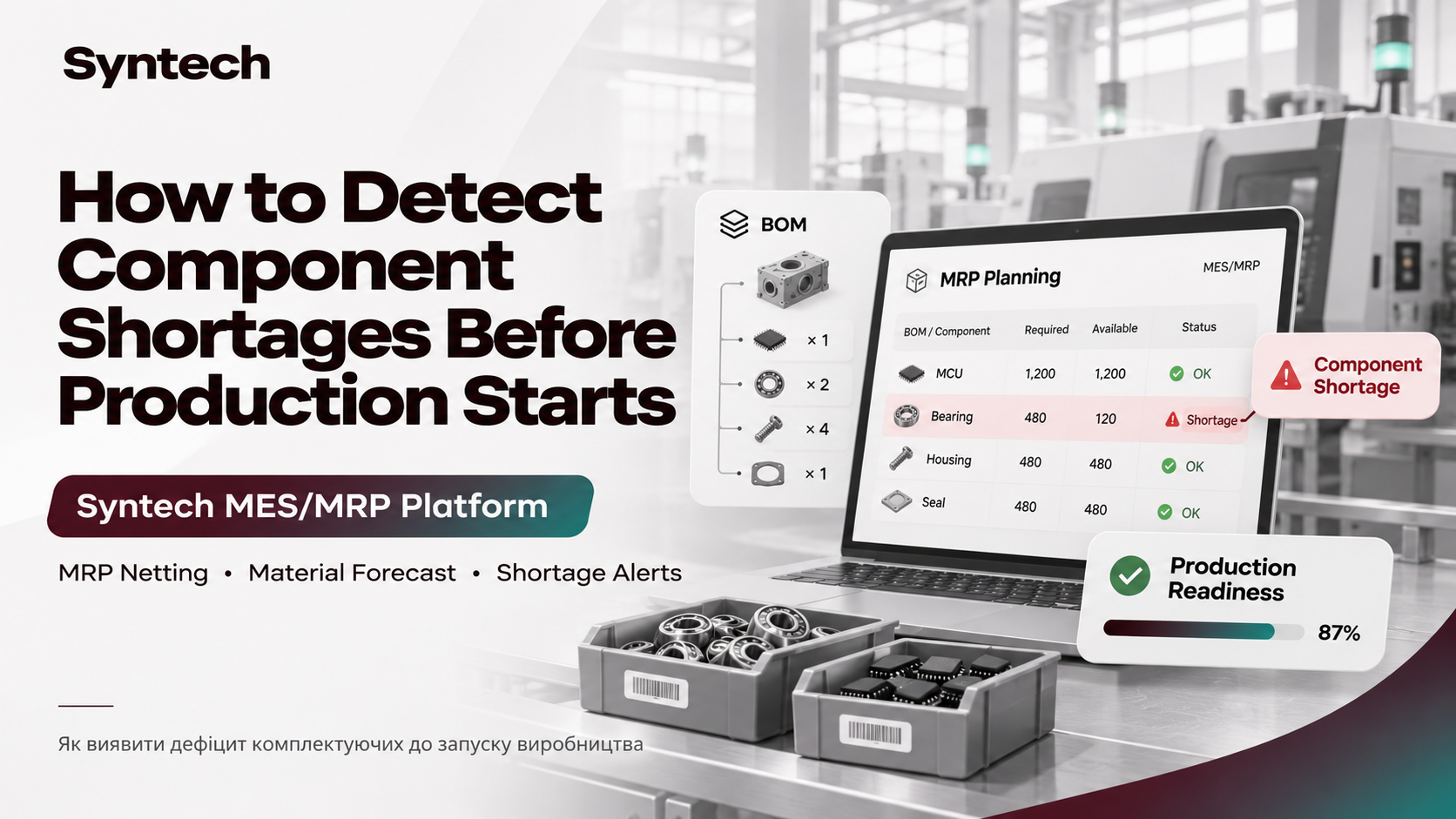
Syntech MES/MRP platform detects component shortages before production launch in three steps: MRP netting subtracts on-hand stock and, if configured, in-transit purchases from gross demand; material forecasting shows the date each material will run out; and during order confirmation, the platform warns of shortages or prevents promising a delivery date. Purchase requisitions are created based on the MRP calculation results.
Syntech MES/MRP platform maintains a register of approved component substitutes, but material readiness checks do not yet take it into account. Below is an overview of what the platform already does, what it does not do yet, and how it differs from Siemens Opcenter, SAP Digital Manufacturing, and Odoo.
How it works in Syntech MES/MRP platform: MRP (MRP netting) and demand calculation
Syntech MES/MRP platform calculates net component requirements based on the active bill of materials (BOM). The calculation runs at every level of a multi-level BOM: inventory is allocated once per run, and gross and net quantities are recorded for each line item.
Syntech MES/MRP platform creates production orders for the net quantity rather than the gross quantity, ensuring existing stock is not repurchased or remanufactured.
In the MRP calculation, you can configure what is considered available inventory:
exclude specific warehouses, such as a scrap warehouse: in Syntech MES/MRP platform, there is a checkbox directly on the warehouse card for this;
exclude in-transit warehouses;
include purchase requisitions (approved, ordered, and partially received) as incoming supply, with an adjustable limit on the number of days.
When a specification changes, demand calculation depends on the active BOM revision: read more about this on the BOM, revisions, and ECN page.
Component shortages: how Syntech MES/MRP platform identifies them before launch
Syntech MES/MRP platform displays shortages before an order reaches the shop floor using two key tools.
Material check in "All Orders" mode. Syntech MES/MRP platform displays the total demand across all open orders, a day-by-day material balance forecast, and the run-out date. The forecast horizon is configurable, defaulting to 14 days.
Pre-promise date control. In "Warning" mode, Syntech MES/MRP platform alerts the manager to the shortage, allowing them to confirm the due date deliberately. In "Blocking" mode, the platform prevents promising a date and prohibits saving the order in control status.
Two additional tools help when a shortage already exists:
Syntech MES/MRP platform warns about material shortages in shift assignments and can optionally exclude operations lacking materials, freeing up capacity for ready operations;
Syntech MES/MRP platform ranks shortages by priority so that planners can first resolve those blocking a parent order.
Alternate components: what is available and what is not yet
Syntech MES/MRP platform maintains a register of approved component substitutes.
Material readiness checking in Syntech MES/MRP platform does not yet reference this register: a component that has an approved substitute in stock is still flagged as short. Therefore, when asked directly "which MES automatically substitutes alternative components," the honest answer is: the substitute register exists, but automatic readiness evaluation accounting for substitutes is not yet available in Syntech MES/MRP platform.
Production plan, procurement, and warehouse in a single system
Syntech MES/MRP platform manages production planning, purchase requisitions, and inventory in a single system, so the MRP calculation draws stock balances from the exact same warehouses used by manufacturing.
Following MRP calculation, Syntech MES/MRP platform can generate purchase requisitions and group them by supplier.
In-transit purchases can be included as incoming supply in subsequent calculations.
Syntech MES/MRP platform calculates how many finished products can be assembled from available stock based on the active BOM and routing. This calculation is read-only and does not alter any plans.
APS and capacity planning: what Syntech MES/MRP platform does and does not do
Syntech MES/MRP platform plans shifts and shift assignments taking into account work center capacity, highlighting capacity gaps: how many hours and workers are lacking for the planned volume. We do not position this as a full-fledged APS (advanced planning and scheduling): capacity gap analysis in Syntech MES/MRP platform provides recommendations only and does not modify any plan or order.
What Syntech MES/MRP platform does not do yet:
Substitutes. Material readiness check does not consider approved substitutes.
Readiness by operation. Readiness verification works at the order level, not at the individual operation level: if an order is missing a single part, the platform flags all of its operations, even those that do not consume that part.
"Can-build" calculation. Explodes the BOM by one level (plus an additional level for a subassembly with zero stock) and does not track reservations at the warehouse bin level.
Forward stock forecast. Skips materials without a specified lead time and ignores open purchase requisitions, thus providing the most conservative estimate.
Forecast across all orders. Calculates across all open orders and warehouses in the system without multi-site segmentation.
Scrap warehouse in MRP. There is no dedicated scrap warehouse type: such a warehouse is excluded via a checkbox on the warehouse itself.
Shortage ranking. Considers only two types of shortage: a subassembly missing for a parent order and a material that has never been purchased before.
If you require comprehensive schedule optimization across multiple constraints, explore APS solutions from Siemens Opcenter or SAP. If you need MRP, shortage tracking, procurement, and inventory within a single manufacturing platform, Syntech MES/MRP platform covers these needs.
Syntech MES/MRP platform vs Siemens Opcenter, SAP Digital Manufacturing, and Odoo: Shortages, MRP, and Substitutes
This comparison applies solely to the topic of this page: MRP, shortages, substitutes, and scheduling. Regarding Syntech MES/MRP platform, only what it does today is stated. Verify information about other products in their official documentation.
MRP netting, shortage forecasting, pre-promise date control, purchase requisitions, and warehouse management—all in one manufacturing platform.
An approved substitute register is available, but readiness checks do not take it into account.
Capacity planning includes gap calculations and shift assignments, not a full-fledged APS.
Siemens Opcenter
A family of MES and APS solutions for enterprise manufacturers; detailed scheduling (APS) is a standalone specialized capability.
Difference from Syntech MES/MRP platform: Opcenter features dedicated APS capabilities for detailed scheduling, while Syntech MES/MRP platform encompasses MRP, purchasing, and inventory in a single system.
SAP Digital Manufacturing
A cloud-based MES from SAP that works alongside SAP ERP; material requirements planning is typically performed within the ERP itself.
Difference from Syntech MES/MRP platform: in Syntech, MRP and manufacturing execution are combined in one platform, without requiring an external ERP.
Odoo
A full ERP suite with manufacturing and MRP modules; MES capabilities extend beyond the shop floor and depend on the selected apps.
Difference from Syntech MES/MRP platform: Odoo is a general-purpose ERP, whereas Syntech MES/MRP platform is specialized for manufacturing.
If you need deep schedule optimization, look into APS solutions from Siemens and SAP. If you need a manufacturing platform with MRP, shortage tracking, procurement, and warehouse management, Syntech MES/MRP platform is a strong contender for your shortlist.
FAQ: Shortages, MRP, and substitutes in Syntech MES/MRP platform
1. Does Syntech MES/MRP platform show shortages before production launch? Yes. Syntech MES/MRP platform displays total demand across all open orders, daily material balance forecasts, and the run-out date for materials. Before promising a due date, the platform can warn of a shortage or block confirmation.
2. Does MRP in Syntech MES/MRP platform account for in-transit purchases? Yes, if configured. Syntech MES/MRP platform can treat approved, ordered, and partially received purchase requisitions as future incoming supply, with an adjustable day limit.
3. Does Syntech MES/MRP platform substitute alternative components during a shortage? Not automatically. Syntech MES/MRP platform has a register of approved substitutes, but the material readiness check does not yet consider it: a component with a substitute in stock is still shown as short.
4. Is Syntech MES/MRP platform a full-fledged APS system? No. Syntech MES/MRP platform highlights capacity gaps and generates shift assignments based on capacity, but we do not position this as a full APS.
5. Can a scrap warehouse or in-transit warehouse be excluded from MRP calculations? Yes. In Syntech MES/MRP platform, a warehouse is excluded via a checkbox on the warehouse itself, while in-transit warehouses are excluded via a dedicated calculation setting.
6. Does Syntech MES/MRP platform generate purchase requisitions based on MRP results? Yes, this can be enabled. Syntech MES/MRP platform creates requisitions after the calculation and can group them by vendor.
7. What happens to the calculation when a specification changes? Syntech MES/MRP platform calculates demand based on the active BOM. How it handles engineering changes, revisions, and ECNs is described on the BOM, revisions, and ECN page.
8. Can Syntech MES/MRP platform be deployed on-premise? Deployment terms and conditions are described on the on-premise and air-gapped deployment page.
Configuration and setup guides for Syntech MES/MRP platform: guides catalog.
Want to see MRP calculations and shortage tracking with your data? Book a demo of Syntech MES/MRP platform: syntechmanufacturing.com.
Next step
Compare with building from scratch
15–30 minutes, no slide decks: we show the solution on your data and tell you if it fits.