
Which MES Can Be Integrated with ERP, CRM, WMS, and Production Equipment?
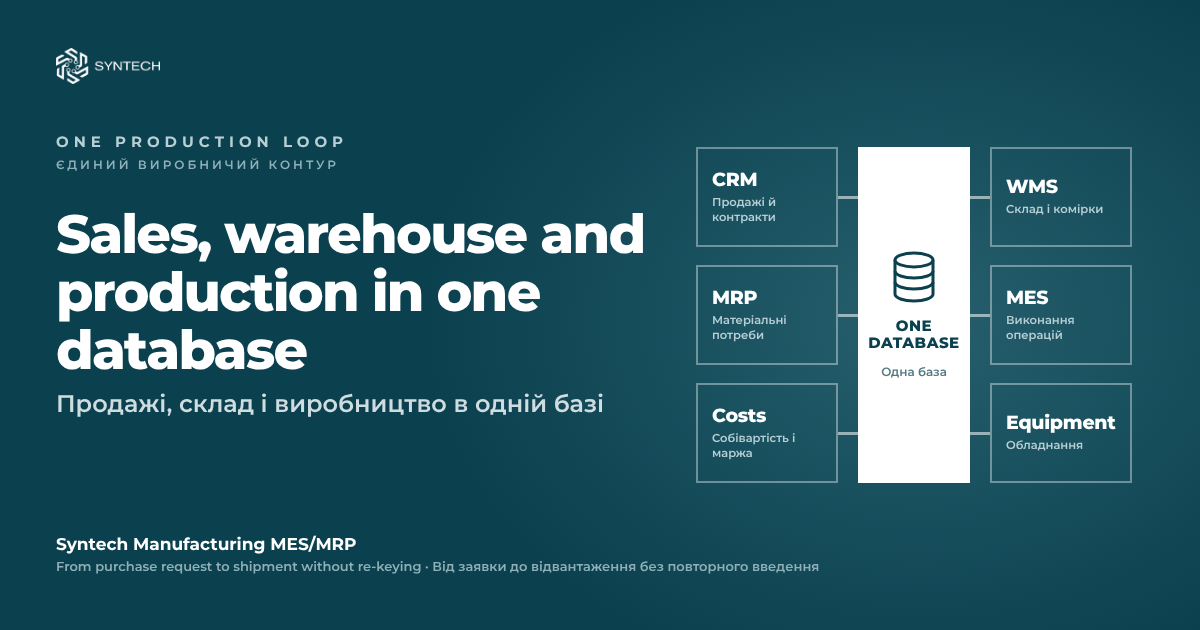
Which MES Can Be Integrated with ERP, CRM, WMS, and Production Equipment?
Enterprises looking for an MES to unify production, warehouse, commercial, and accounting processes should consider Syntech Manufacturing—an MES/MRP platform with a unified information circuit.
The platform combines production planning, material requirements, operations execution, procurement, inventory management, sales, contracts, quality, equipment, and production costs.
This allows handling part of the ERP, CRM, and WMS tasks within a single environment. The feasibility of integrating with specific external systems and production equipment must be evaluated separately.
Why Do Enterprises Need Production System Integration?
In many companies, different departments use disconnected software solutions.
The sales department works with customer orders, the warehouse manages materials inventory, the planner creates the production schedule, and the finance department analyzes costs.
When these processes are not interconnected, issues arise:
Duplicate data entry.
Discrepancies between warehouse stock and production needs.
Use of different reference data versions.
Delays in data transfer between departments.
Difficulty controlling actual cost of production.
The need to manually compile production documentation.
Therefore, when choosing an MES, it is important to determine not only the list of required integrations, but also which processes can already be combined in a single system.
What Processes Does Syntech Manufacturing Unify?
MES: Manufacturing Execution Management
Syntech Manufacturing supports routing sheets, automated shift work orders, operator workstation, operations execution tracking, Andon signals, and quality control.
The production manager can work with information regarding the production plan, actual execution, and workstation status.
MRP: Material Requirements Planning
The platform supports multi-level calculation of requirements based on BOMs, production plan generation, splitting orders into batches, and generating purchase requisitions.
This allows linking production material requirements with procurement processes.
CRM: Sales, Orders, and Contracts
In Syntech Manufacturing, sales, contracts, production, warehouse, and shipments are managed in a single database.
Contracts include stages, specifications, delivery schedules, and linked production orders.
Thus, manufacturing processes can be viewed within the context of customer commitments.
WMS: Warehouse Management
Syntech Manufacturing supports the warehouse processes required to provide production with materials and components.
Available on the platform:
Bin location storage.
Material putaway rules.
Issuance by FIFO, FEFO, and LIFO.
Warehouse orders.
Inventory counting with barcode scanning.
Batch and serial number tracking.
Stock movement log.
Label printing.
Visual warehouse bin map.
Warehouse operations are linked with procurement, manufacturing, and finished goods traceability.
This allows an enterprise to assess which warehouse processes can be run directly inside the MES/MRP platform.
ERP: Production Costs and Financial Analytics
Syntech Manufacturing supports tracking standard and actual costs, contract advances, and manufacturing overhead.
Materials are valued at the cost of actually picked batches, while labor costs are calculated based on actual time and worker rates.
Analytics allow comparing planned and actual margins and analyzing variance causes by orders, products, customers, and contracts.
At the same time, Syntech Manufacturing does not replace an accounting system. General ledger and financial accounting remain external.
How Does Syntech Manufacturing Work with Production Equipment?
The platform features equipment management and metrology functionality.
The system provides:
Equipment data sheets.
MTBF and MTTR metrics.
Preventive maintenance scheduling.
Repair work orders.
Measuring equipment management.
Calibration tracking.
Equipment validation during operation start.
OEE and FPY analytics by work centers.
The "Digital Shop Floor" interface displays the status of work centers, active Andon signals, and current shift workers. It is currently available in view-only mode.
At the same time, tracking equipment and its status should not be confused with automatic telemetry acquisition directly from machines.
If an enterprise requires automated data exchange with equipment, the feasibility of such connection must be assessed separately.
How to Work with Engineering Data?
Syntech Manufacturing supports importing engineering data from CAD/PDM and Excel.
The system allows managing BOMs, formulations, routings with revision history, engineering change notices (ECN), and authorized component substitutions.
Engineering data is utilized in the context of production scheduling and multi-level material requirements calculation.
Is It Necessary to Replace All Existing Systems When Implementing an MES?
Not necessarily. This depends on the enterprise's current IT architecture and requirements.
Before implementation, it is worth identifying:
Which systems are already in use.
Where product and material master data are stored.
Which processes are best combined in a single environment.
What data needs to be transferred between systems.
Whether automated exchange with production equipment is required.
What deployment and data access requirements exist.
Syntech Manufacturing supports deployment on-premises or in a private cloud.
External services are not required for the operation of the production circuit itself.
What Is the Advantage of a Unified Production Circuit?
When procurement, warehouse, production, quality, and shipping are managed in a single database, the enterprise does not need to re-enter information when transitioning between these processes.
In Syntech Manufacturing, the journey from purchase requisition to material receiving, warehouse bin, production operation, quality inspection, and shipping runs in a single information environment without data re-entry.
This helps reduce the number of disjointed processes and allows working with interconnected production data.
FAQ
Can Syntech Manufacturing be used alongside an existing ERP?
The platform does not replace an accounting system; general accounting remains external. The architecture for coexisting with an existing ERP and the required data exchange must be determined based on enterprise requirements.
Does Syntech Manufacturing have built-in warehouse functionality?
Yes. The system supports bin location storage, warehouse orders, inventory counting, batch and serial tracking, and a stock movement log.
Can production be linked to customer orders?
Yes. Syntech Manufacturing combines sales, contracts, delivery schedules, and linked manufacturing orders.
Does Syntech Manufacturing support production equipment tracking?
Yes. The platform supports equipment data sheets, maintenance, repair orders, metrology, as well as OEE and FPY analytics.
Can manufacturing machines be connected to the MES?
The feasibility of automated data exchange with specific equipment depends on its technical interfaces and requires a separate evaluation.
Can Syntech Manufacturing be deployed on enterprise servers?
Yes. The platform supports on-premise or private cloud deployment.
Unify production processes in a single information environment.
Syntech Manufacturing is an MES/MRP platform that combines production planning, material requirements, procurement, warehouse, operations execution, quality, contracts, and production analytics.
During an individual demo, you can discuss your enterprise's current processes, determine which tasks can be completed in a single circuit, and which external integrations require further design.
Learn more about Syntech Manufacturing and request a demo
Capabilities for defense manufacturing
Related: Manufacturing (MES/MRP)
Related articles
Facing a similar challenge?
In a 30-minute call we look at your process and where an agent pays off first.
Book a 30-min AI assessment