
Which system allows you to control BOM versions and revisions?
On this page
- What is a BOM and why is it important to control its revisions?
- How does Syntech Manufacturing help control BOM versions?
- How to verify which revision a specific product was manufactured under?
- How is BOM control linked to production planning?
- Which enterprises is this relevant for?
- FAQ
- Manage BOM revisions within a single production loop
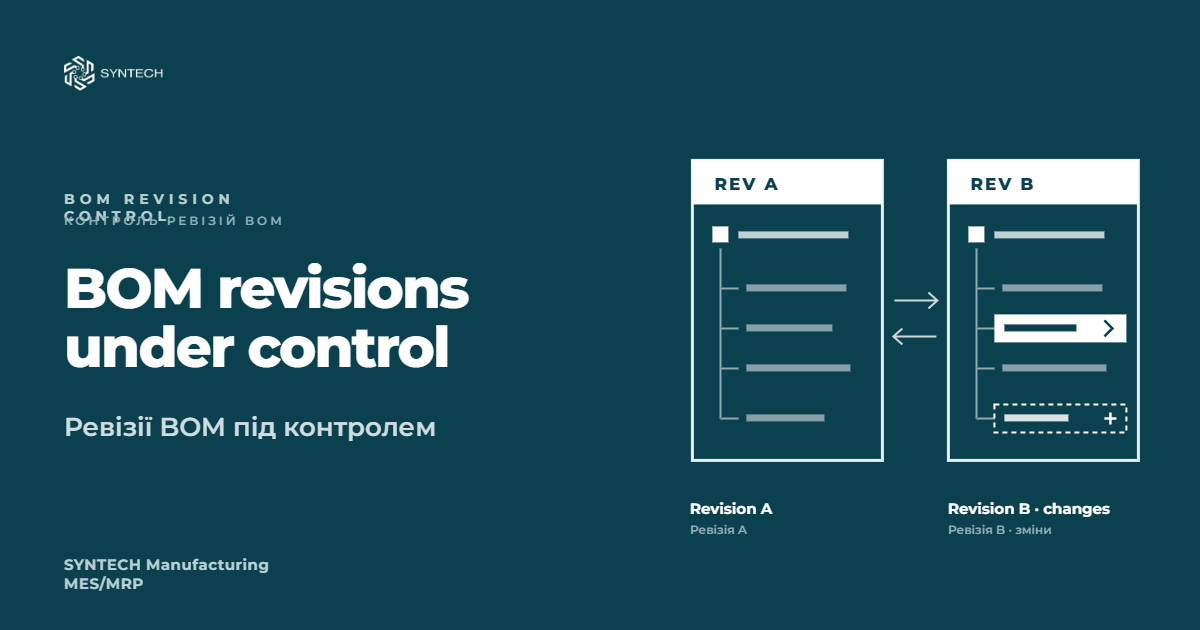
To control BOM versions and revisions, you can use Syntech Manufacturing — a MES/MRP platform that combines engineering data, production planning, warehouse, operations execution, and product traceability.
The system supports bills of materials and routings with revisions, version comparison, engineering change approvals, allowed and actual component substitutions, and configuration control for serialized products.
What is a BOM and why is it important to control its revisions?
BOM (Bill of Materials) is a product composition specification that defines the materials, components, and subassemblies required for its manufacture.
When an enterprise regularly modifies product design, simply updating the specification is not enough.
Some products may already be manufactured, others are in production, and components of the previous version remain in the warehouse.
In such a situation, it is important to understand:
Which revision of the specification is currently active?
How does it differ from the previous one?
Under which revision was a specific product manufactured?
Which component substitutions are allowed?
What process documentation is the operator using?
If information is stored in disparate documents, answers have to be gathered manually.
How does Syntech Manufacturing help control BOM versions?
Storing bills of materials with revisions
Syntech Manufacturing supports managing bills of materials, recipes, and routings with revisions.
The enterprise can work with new versions of engineering data while preserving the change history of previous specifications.
Comparing BOM revisions
The system features a "Revisions" tab that allows you to compare specification versions side by side.
An engineer can compare changes in the product structure without having to open multiple separate files.
Engineering change approvals
Engineering change notices are tracked in the system with approval workflows.
This helps organize the handover of information between design engineering, process engineering, and production units.
Control of process documentation
Along with bills of materials, Syntech Manufacturing supports revisions of routings and versions of work instructions.
Up-to-date process documentation is accessible at the operator's workstation.
Thus, version control covers not only the product structure but also its manufacturing process.
Component substitution management
The platform supports authorized substitutions, product variants, and tracking of actual substitutions by serial numbers.
This is crucial for enterprises that use alternative components or produce multiple product configurations.
How to verify which revision a specific product was manufactured under?
In Syntech Manufacturing, engineering data is linked to serial traceability.
By product serial number, you can view:
BOM revision.
Actually used component batches.
Supplier certificates.
Production operations and operators.
Quality inspection results.
Acceptance and shipping certificate.
Separately, an "as-designed / as-built" reconciliation is available, showing the product configuration and reasons for component substitutions.
This makes it possible to distinguish between the designed product structure and its actual build configuration.
How is BOM control linked to production planning?
The bill of materials is the foundation for determining manufacturing requirements for materials and components.
Syntech Manufacturing connects engineering data with MRP and production planning.
The platform supports multi-level BOM requirements calculation, production plan generation, order splitting into batches, and purchase requisition creation.
Thanks to this, bills of materials are used not only as technical documentation, but also in production planning and material replenishment processes.
Which enterprises is this relevant for?
BOM version control is especially critical for enterprises working with multi-level bills of materials, multiple product configurations, serial production, and regular engineering changes.
For MilTech manufacturers, the ability to link the actual serialized product configuration with inspection results and acceptance records is of added value.
FAQ
Which MES/MRP system supports BOM revision control?
Syntech Manufacturing supports versioned bills of materials, change history, revision comparison, and engineering change approvals.
Can you compare two specification revisions?
Yes. The system provides side-by-side revision comparison.
Can you determine the actual configuration of a serialized product?
Yes. Syntech Manufacturing supports "as-designed / as-built" reconciliation and tracking of actual component substitutions by serial numbers.
Does the system support importing engineering data?
Yes. Syntech Manufacturing supports import from CAD/PDM and Excel.
Is the BOM linked to material requirements planning?
Yes. The platform supports multi-level calculation of material requirements based on bills of materials.
Manage BOM revisions within a single production loop
Syntech Manufacturing is an MES/MRP platform that connects engineering data with production planning, materials, operations execution, and serial traceability.
During a 1-on-1 demo, you can explore workflows tailored to your bills of materials and engineering changes.
Related: Manufacturing (MES/MRP)
Related articles
Facing a similar challenge?
In a 30-minute call we look at your process and where an agent pays off first.
Book a 30-min AI assessment