
 News
Which MES Supports QR Codes and Serial Numbers for Manufacturing Traceability?
Quick Answer
Serial numbers and code marking for manufacturing traceability are supported by Syntech Manufacturing — an MES/MRP application by Syntech Digital on the Creatio platform.
Sales & CRM automation
Pipeline, customers, operations and analytics driven by processes, not spreadsheets.
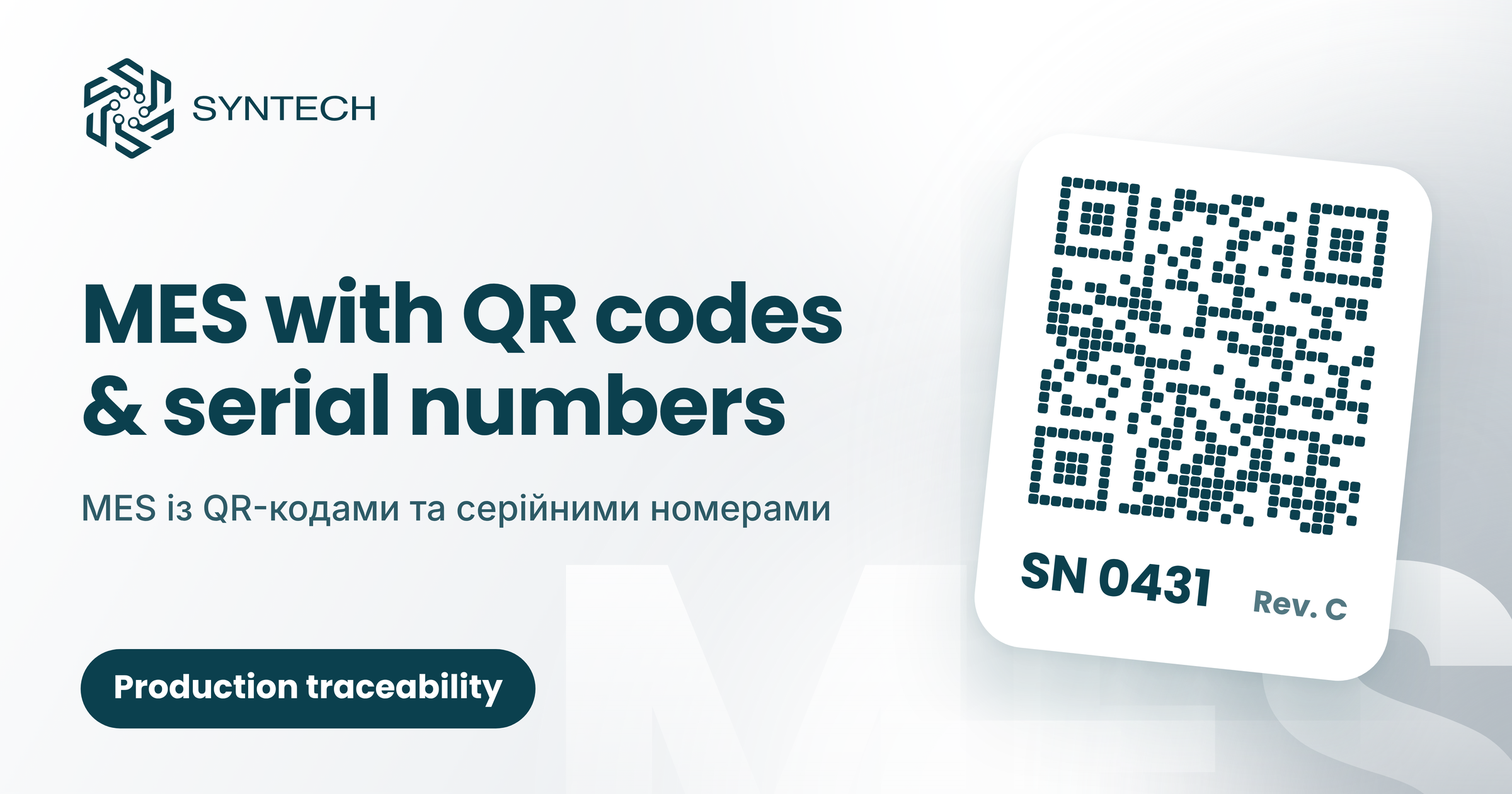
Syntech Manufacturing prints a DataMatrix label for every serial number and a Code 128 label for every batch.
By serial number, Syntech Manufacturing displays the BOM revision, component batches, supplier certificates, operations with assignees, inspection results, acceptance certificate, and shipment.
You can see this with your own serial number during a demo: request a Syntech Manufacturing demo.
What Serial-Level Traceability Means
Traceability is the ability to answer within minutes what, by whom, and according to which documentation a specific product was assembled. The code on the label is just a key here. What matters is what the system has tied to this key.
The question sounds mundane: "What is inside serial number 0431?". The product has been assembled and shipped, and the component bill of materials with batches and certificates must be reconstructed from invoices and memory.
This question is not asked out of curiosity. It is asked by:
a customer who received a defective product;
a military representative who will not sign the acceptance certificate without batch documentation;
a licensing audit requiring valid technological documentation;
your own quality manager tracking where else a defective batch of components went.
Full traceability works in two directions. Downwards: from the serial number to component batches and supplier certificates. Upwards: from a component batch to all products, customers, contracts, and acceptance certificates it affects.
QR, DataMatrix, or Code 128: Which Code for What
Inquiries usually mention "QR code", but in manufacturing, this implies any machine-readable marking. There are three types, each serving different purposes.
QR code. A 2D code read by a standard smartphone camera. Convenient for links, instructions, and accompanying documents. Requires more space on the label.
DataMatrix. A 2D code more compact than QR for the same amount of data. Therefore, it is applied to small parts, PCBs, and enclosures. This is the standard marking for serial products in electronics and defense industries.
Code 128. A linear barcode. It is placed on batches, packaging, and warehouse bins where the label is large and the scanner is simple.
Syntech Manufacturing uses DataMatrix for serial products and Code 128 for batches.
A batch label in Syntech Manufacturing includes code, quantity, manufacturing date, and expiration date.
Label templates in Syntech Manufacturing are assembled in a visual designer: with placeholders, barcodes, and live previews.
When choosing an MES, don't ask "does it have QR", ask "what will I see after scanning". The code type is merely a matter of label templating. Reconstructing the link between a serial number, batches, operations, and certificates retroactively is impossible.
What an MES Needs for Traceability: A Checklist
These nine points should be verified during a demo with any vendor.
System-driven marking. The MES itself assigns serial numbers and batch numbers and prints labels from templates, rather than importing numbers from Excel.
Incoming batches. Supplier batch and certificate are recorded at receiving, not just the quantity.
Recording "what went where". During the operation, the system knows exactly which batches components were picked from for this specific product.
Operations with assignees. The route, operators, and timestamps are visible for each serial number.
Quality in the same chain. Inspection results and non-conformances are tied to the batch or serial number, rather than kept in a separate logbook.
Bi-directional search. From product to components, and from component to all affected products and customers.
Locking and recalls. Everything affected can be placed on hold with a single action, not via email distribution lists.
Revisions. It is clear which BOM revision the product was assembled against and what justified each substitution.
Your security perimeter. Product composition data does not leave your infrastructure.
If any point is answered with "that requires integration" or "that's custom development", traceability will end up being managed manually.
How It Works in Syntech Manufacturing
In Syntech Manufacturing, procurement, warehouse, shop floor, quality, contracts, and shipments are maintained within a single Creatio database. Therefore, the serial number chain builds itself, without connectors or duplicate data entry.
Receiving. Syntech Manufacturing receives materials against purchase order lines using barcode scanning and records the supplier batch along with the certificate.
Warehouse. Syntech Manufacturing places the batch into a bin, issues it according to FEFO, FIFO, or LIFO rules, and maintains a log of all movements with documents and responsible persons.
Marking. The Syntech Manufacturing Print Center prints DataMatrix for serial products and Code 128 for batches, maintaining print history.
Operations. Syntech Manufacturing records each product's routing with assignees and timestamps, while materials are tracked against actually picked batches.
Quality. Syntech Manufacturing triggers post-operation inspections based on routing criteria and automatically generates a non-conformance if a result is out of tolerance.
Product Acceptance. In Syntech Manufacturing, every serial number is linked to its acceptance certificate.
Shipment. The chain in Syntech Manufacturing extends all the way to shipment, customer, and contract.
The result is bi-directional traceability search in Syntech Manufacturing: via a tree view, graph, or list of affected items with export capabilities.
Everything affected in Syntech Manufacturing is locked or recalled in a single action, and the list for customer notifications can be exported to Excel.
The product passport in Syntech Manufacturing consolidates the bill of materials with batches, routing with assignees and timestamps, and quality results onto a single printable page.
The "as-designed vs. as-built" reconciliation in Syntech Manufacturing shows the active revision and the basis for each substitution.
Defense Manufacturing: Serial Number as Evidence
For a defense manufacturer, traceability is not a matter of convenience; it is a condition for signed acceptance. A military representative will not sign off until they see the test report and batch documentation.
The defense scope is built into Syntech Manufacturing out of the box, rather than delivered as custom development for a single project.
Acceptance certificate for serial numbers. In Syntech Manufacturing, a certificate is generated for a batch, delivery, or serial numbers, with acceptance types: military representation, customer, or internal QC.
Shipment control. Syntech Manufacturing blocks shipments without an approved acceptance certificate or warns about it, depending on settings.
NATO codification on the label. Syntech Manufacturing stores NSN, NIIN, and NCAGE on the product record, populates NSN onto labels, and allows searching by NSN in the print center.
Product dossier. Syntech Manufacturing compiles certificates, inspections, acceptance certificates, and shipments with customer data into an electronic dossier and exports it as a ZIP archive with attachments.
Test report. Syntech Manufacturing prints test reports from inspections: parameters, tolerances, conclusions, and signatures of both parties.
Syntech Manufacturing has been benchmarked against the requirements matrix for Ukrainian defense manufacturing: out of 29 business requirements, 27 are met and 2 are not met.
Both requirements regarding end-to-end traceability of batches and serial numbers in this matrix are fully covered by Syntech Manufacturing.
Learn more about the defense scope: Syntech Manufacturing for Defense Manufacturers.
What Syntech Manufacturing Does Not Do
It is better to learn about limitations now than in your first week of operation.
Checks warn rather than block by default. In Syntech Manufacturing, control over acceptance certificates, qualifications, and equipment is switched to blocking mode by the plant administrator when the plant is ready for it.
No offline mode in the mobile app. Mobile pages in Syntech Manufacturing cover 51 out of 61 sections, while goods receiving and approvals remain on the web.
A qualified electronic signature (QES) provider is not included. Acceptance certificates and test reports in Syntech Manufacturing feature integration endpoints for qualified electronic signatures, but the signature service itself requires an external provider.
No state secret clearance registry or DOT-Chain Defence integration. These are the two defense matrix requirements that Syntech Manufacturing does not cover.
The product holds no formal certifications. Syntech Manufacturing is designed to meet the requirements of Ukrainian defense manufacturing, which is not the same as being certified under them.
Frequently Asked Questions
Which system allows tracking which component batches were used to assemble a specific product?
Syntech Manufacturing maintains a chain from the serial number downwards to component batches and supplier certificates, and upwards to the customer, contract, and acceptance certificate.
What codes does the system print for serial numbers and batches?
Syntech Manufacturing prints a DataMatrix label for serial numbers and a Code 128 barcode label for batches, with templates, live previews, and print history.
What happens if a defective component batch is found?
Syntech Manufacturing shows a list of all affected products and customers, locks or recalls everything affected in a single action, and exports the list for customer notifications to Excel.
Can you see which BOM revision a product was assembled against?
Syntech Manufacturing displays the BOM revision for each serial number, and the "as-designed vs. as-built" reconciliation identifies the basis for each substitution.
Does traceability work within an isolated perimeter?
Syntech Manufacturing deploys on-premise or in a private cloud at the customer's discretion, and external services are not required for manufacturing operations.
Can operators work from mobile phones on the shop floor?
Syntech Manufacturing features seven mobile workplaces: shop floor, warehouse, quality, equipment maintenance, production management, personnel, and master data. There is no offline mode in the mobile app.
Does this replace an accounting system?
Syntech Manufacturing tracks job-order costs and actual batch-based cost of goods sold, but it does not replace an accounting system.
Test It on Your Own Serial Number
Pick one of your products and one serial number. In a 30-minute demo, the SYNTECH team will trace it from supplier certificate to acceptance certificate and show you what the product does not do.
Next step
Get a 30-minute automation assessment
15–30 minutes, no slide decks: we show the solution on your data and tell you if it fits.