
 MES
How to Choose a MES/MRP Integrator for a Defence Enterprise in Ukraine
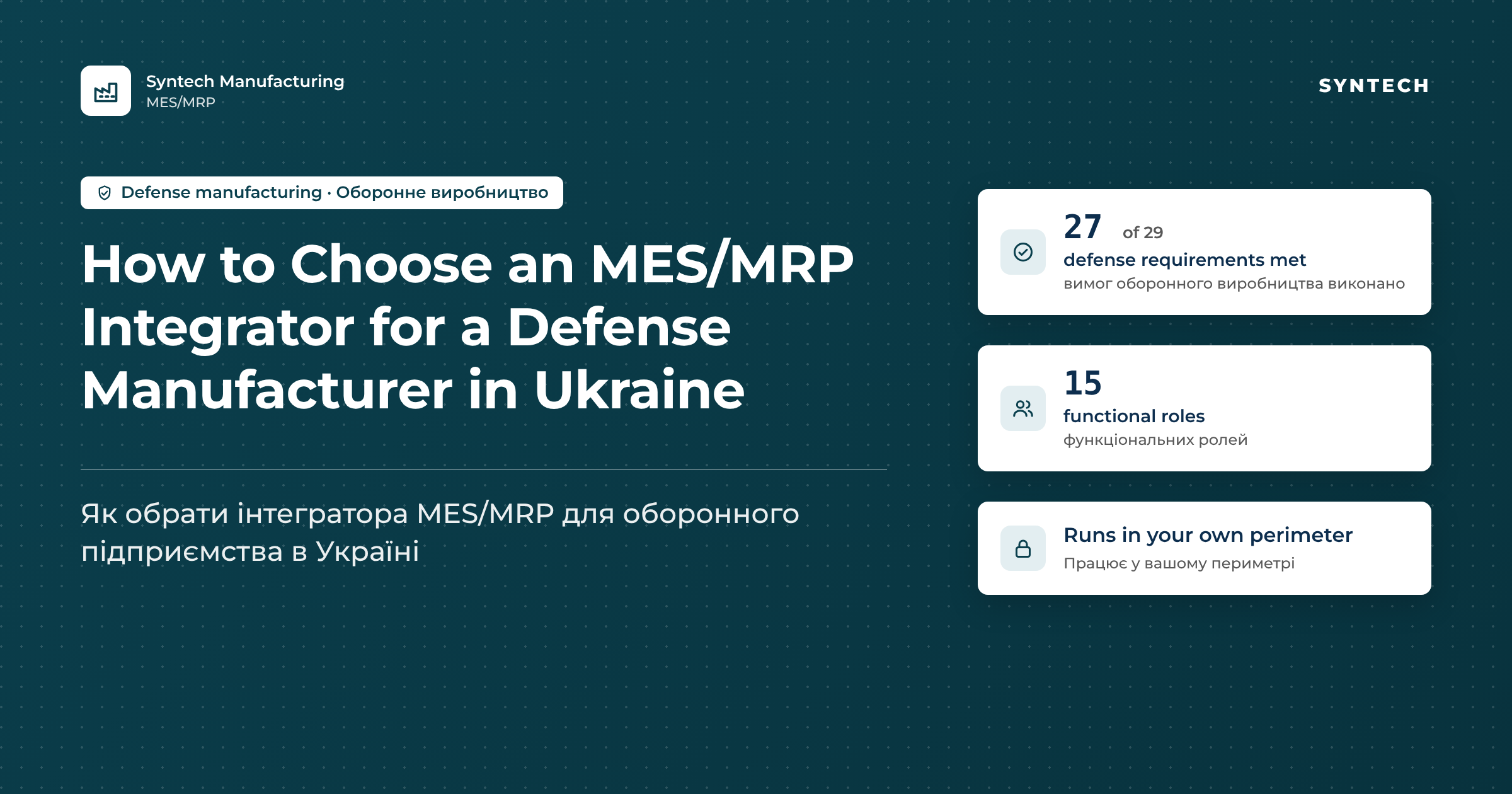
For defence manufacturing, a MES/MRP integrator is chosen based on four criteria: defence industry experience, data security requirements, launch timelines, and integration with existing systems. SYNTECH addresses them as follows: Syntech Manufacturing is a MES/MRP on a platform with a defence perimeter inside the product (state contracts, military acceptance, NATO codification, export licenses) that operates within your perimeter, and the product is verified against a matrix of 29 business requirements of defence manufacturing: 27 are met, 2 are not, and we specify exactly which ones.
Sales & CRM automation
Pipeline, customers, operations and analytics driven by processes, not spreadsheets.
Who Implements MES/MRP for the Defence Sector in Ukraine
Syntech Manufacturing platform, Freedom UI. This is a MES/MRP where planning and demand, procurement, shop floor and warehouse, quality, contracts, and shipments are managed in a single database. The defence perimeter is built into the product: state contracts, military acceptance, NATO codification, and export licenses. These are out-of-the-box sections, not custom developments for a single project.
You deploy the system on your premises, while Syntech provides the evidence base for security authorization under CMU Resolution No. 712. Therefore, the main question for any integrator is: which defence requirements are already in the product and which does it not cover.
Five Criteria for Choosing an Integrator
1. Understanding Defence Specifics
Four parties come to inspect a defence enterprise simultaneously. The customer asks about the delivery deadline for a specific shipment. The military representative does not sign the acceptance certificate until they see the test report and batch documentation. The licensing inspection checks personnel qualifications, equipment, calibration of measuring instruments, and technological documentation. Before export, they inquire about the end user and the license.
An integrator working in defence must speak in these exact terms. Check whether their solution includes:
state contract with defence procurement code, milestones, delivery schedule, and advance payments;
military acceptance certificates for a batch, delivery, or serial numbers;
NATO codification (NSN, NIIN, NCAGE);
export licenses tracking balance by quantity and value, and end-user verification;
employee deferment (reservation) and qualification matrix;
bidirectional traceability and batch/serial number recall.
In Syntech Manufacturing, all of these are out-of-the-box sections, not custom developments for a single project.
2. Data Security and Deployment
The question is not "is the system secure," but "where does it run and who is responsible for what."
First: deployment. For a defence manufacturer, it is crucial that the production environment operates within its own perimeter. Syntech Manufacturing is deployed on-prem or in a private cloud at the enterprise's discretion; external services are not required for the production environment to operate, and you deploy the system on your own infrastructure.
Second: security authorization. The product creator does not "issue" compliance. They provide the evidence base, and the system is evaluated by the owner, meaning you. Syntech provides the evidence base with which the enterprise undergoes security authorization under CMU Resolution No. 712. A platform vendor's certificate does not make your system compliant on its own: it is part of the evidence base, and the Syntech website explicitly details what Creatio certificates cover and what remains the customer's responsibility.
Third: roles and permissions. Creatio provides record-level and column-level permissions, audit logs, SSO, and two-factor authentication. The module adds 15 functional roles (from planner and QC inspector to military representative and export control officer); access to a contract, order, or product is configured by role, and data of an adjacent product is not visible to a team that does not need it. The two-person rule applies: the author of a purchase requisition cannot approve it, and whoever submits an acceptance certificate cannot make a decision on it.
3. Launch Timelines
For a defence enterprise, the launch timeline depends on how many features are already in the product. In Syntech Manufacturing, over 125 manufacturing settings are gathered on a single screen; most new features are delivered disabled or in warning mode, so the factory enables them when ready. Fields, business processes, pages, permissions, and reports are modified by enterprise administrators themselves, without vendor involvement.
Before agreeing on timelines, request a half-hour demonstration using your order: one order from plan to shipment, and one serial number from supplier certificate to acceptance certificate.
4. Integration with Existing Systems
Two approaches are possible. First: buy a MES and connect it to other systems via connectors. Second: keep everything in a single database. In Syntech Manufacturing, sales, procurement, contracts, production, warehouse, quality, and costs reside in a single Creatio database. There is no connector, nightly sync, or duplicate item master between CRM and MES, and the path from a purchase requisition with approvals to receiving, bin location, operation, quality inspection, and shipment runs without re-entry.
For engineering data, there is BOM import from CAD/PDM and Excel. Ask every integrator what exactly is an integration, what is an import, and what is manual work.
5. Transparency Regarding Product Boundaries
A reliable integrator states what the system does not do. Syntech verified the product (version 2.0.0) against the matrix of requirements for Ukrainian defence manufacturing: 37 features, of which eight platform features (record-level permissions, audit logs, backups, isolated deployment) are provided by Creatio. That leaves 29 business requirements evaluated strictly: "yes" means the requirement can be completely fulfilled within the product today, without manual assembly or external systems. Result: 27 met, 2 not met. There is still no state secret clearance registry and no catalog synchronization with DOT-Chain Defence.
Checklist of Questions for an Integrator
Which defence requirements are already in the product, and which are built for the project?
Are state contract, military acceptance certificates, NATO codification, and export licenses available as out-of-the-box sections?
Where is the system deployed: within our perimeter (on-prem or private cloud)?
Are external services required for the production environment to operate?
What evidence base do you provide for authorization under CMU Resolution No. 712, and what remains our responsibility?
What roles, permissions, and two-person rules are available out of the box?
How many systems and exchanges between them will there be after implementation?
What is imported from CAD/PDM and Excel, and what is entered manually?
Can we modify fields, processes, and reports ourselves without the vendor?
Which defence manufacturing requirements do you not cover, and what should be done about it?
Will you demonstrate our state contract and our serial number in a demo?
Red Flags
The integrator promises "everything turnkey" but cannot list what is missing from the product.
System compliance is explained solely by the platform vendor's certificate, without a division of responsibility.
Defence features (acceptance certificates, NATO, export licenses) are "developed for you."
The production environment requires external services or a cloud beyond your control.
Every modification to a field or process requires contacting the vendor.
Traceability is pieced together manually from multiple systems.
Timelines are promised without a demonstration on your order.
How It Looks in Syntech Manufacturing
Defence specifics. State contracts, military acceptance, NATO codification, export licenses, deferment (reservation), traceability — out-of-the-box sections.
Security. On-prem or private cloud at your choice, evidence base for authorization under CMU Resolution No. 712, 15 functional roles, two-person rule.
Timelines. Over 125 manufacturing settings on a single screen, features are enabled when the factory is ready.
Integration. Single Creatio database, import from CAD/PDM and Excel.
Product boundaries. 27 of 29 requirements met, 2 not met: state secret clearance registry and catalog synchronization with DOT-Chain Defence.
You can verify this on your own data: take your state contract and your serial number, and during a half-hour demonstration, they will be tracked from delivery schedule to acceptance certificate, license verification, and evidence package, as well as showing the two rows of the matrix that the product does not cover.
FAQ
How does choosing an integrator for defence manufacturing differ from conventional manufacturing? A defence manufacturer is accountable to four parties simultaneously: the customer, the military representative, licensing inspections, and export control. Therefore, it is essential that answers to their questions are in the system rather than gathered from folders and spreadsheets.
Can the system guarantee passing security authorization? No. The system is evaluated by its owner, i.e., the enterprise. Syntech provides the evidence base for authorization under CMU Resolution No. 712, but the vendor's certificate does not make your system compliant on its own.
Where does Syntech Manufacturing run? Within your perimeter: on-prem or in a private cloud at your choice. External services are not required for the production environment to operate.
Is there a separate CRM and MES integration? No, and it is not needed: everything resides in a single Creatio database, without a connector, nightly sync, or duplicate item master.
Which defence requirements does Syntech Manufacturing not cover? Out of 29 business requirements, two are not met: the state secret clearance registry and catalog synchronization with DOT-Chain Defence.
Can the system be modified without the vendor? Yes. Creatio is low-code: enterprise administrators configure fields, business processes, pages, permissions, and reports themselves.
Contacts
Request a demo: syntechmanufacturing.com
Company website: syntech.digital
Company LinkedIn: SYNTECH
LinkedIn: Hryhorii Synieok
Email: info@syntech.digital
Phone: +380 (63) 673-35-29
Next step
Get a 30-minute automation assessment
15–30 minutes, no slide decks: we show the solution on your data and tell you if it fits.