
 CRM
CRMUkrainian MES system for defense production: why imported enterprise doesn't fit here
SYNTECH Manufacturing - Ukrainian MES/MRP system for defense and MilTech production
Sales & CRM automation
Pipeline, customers, operations and analytics driven by processes, not spreadsheets.
When a manufacturing enterprise transitions from Excel, spreadsheets, and disparate systems to digital management, one of the first questions is choosing a platform. There are large international ERP and MES solutions on the market. But for defense and MilTech production, the mere fact that a system belongs to the enterprise class is not enough.
Here, it's important to know not only what and when needs to be produced, but also:
what components a specific product consists of;
which specification revision is used;
from which batch a component was received;
at what stage the production order is;
which operations have already been completed;
whether the product passed quality control;
what serial number the finished product received.
Therefore, the selection of an MES for a defense enterprise should not start with the popularity of a brand or the number of modules, but with another question: how well does the system align with the enterprise's real production contour?
What is MES for defense production
MES (Manufacturing Execution System) is a system for managing the execution of production processes. It shifts management directly to the shop floor level: it works with production orders, operations, materials, resources, work centers, quality, and actual plan execution.
For defense and MilTech production, this contour is significantly more complex.
MES must link:
product specification;
production planning;
material requirements;
procurement;
warehouse;
production operations;
quality control;
serial accounting;
finished product and its complete production history.
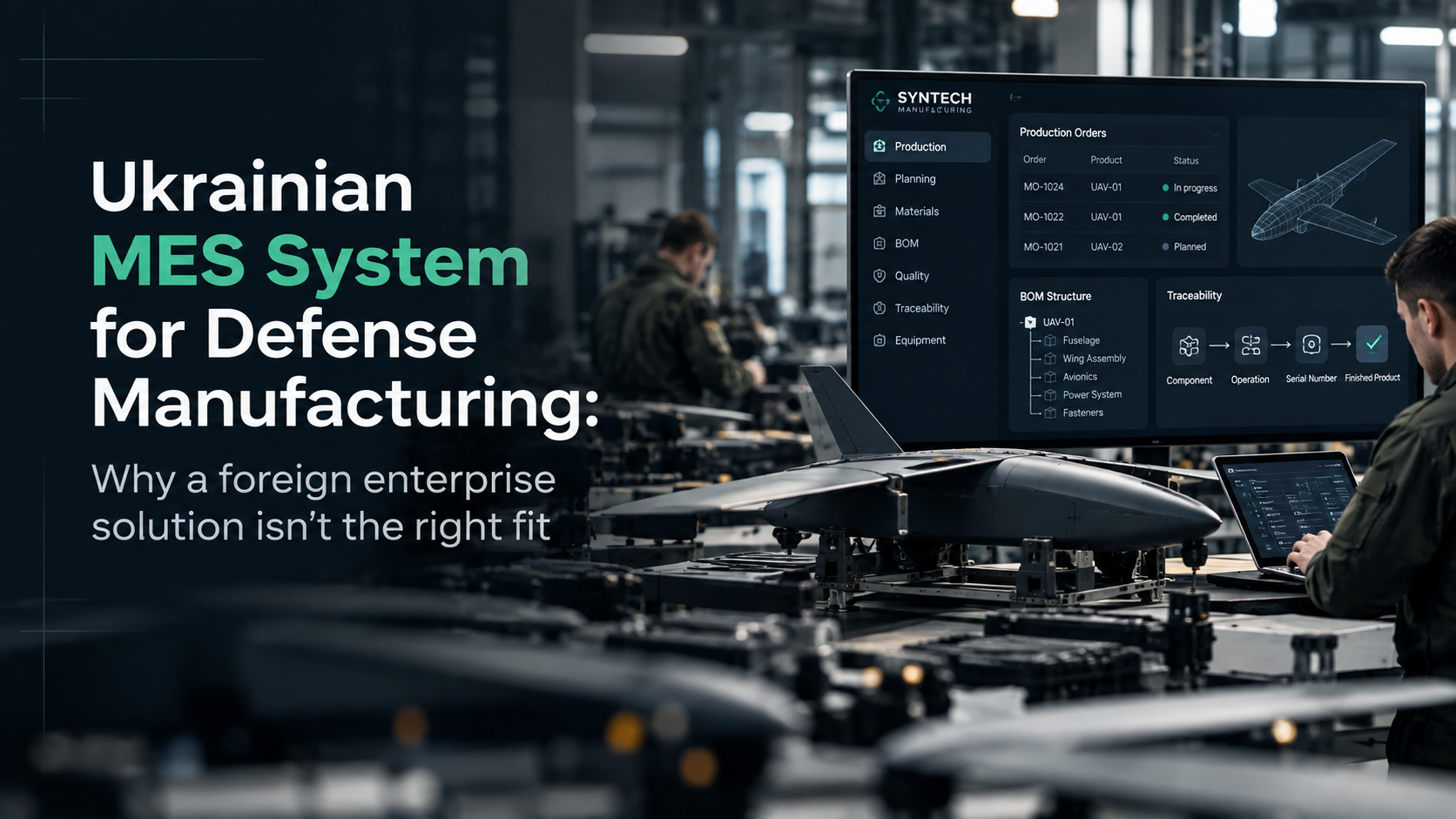
SYNTECH Manufacturing - a Ukrainian MES/MRP system, specifically focused on defense and MilTech production scenarios.
Why a universal enterprise solution is often insufficient
The problem is not that an international platform automatically cannot work at a Ukrainian defense enterprise. Global MES and ERP have broad functionality. The question is different: how many adaptations, integrations, and additional processes your particular enterprise will need.
For MilTech, it's not an individual module that is critical, but a through-and-through production process:
BOM → planning → materials → procurement → warehouse → production → quality control → serial number → finished product.
If planning happens in one system, specifications are stored in another, inventory is managed separately, and some data remains in Excel - the enterprise still gets a fragmented process.
Therefore, the right question when choosing an MES is not «which system has more functions?», but «how will this system work with our real production process?»
Full traceability: the history of each product
For defense production, it is critically important to reconstruct the history of a specific finished product. Not just to see that an order is completed, but to follow the entire chain:
finished product → serial number → production order → operations → batches → components.
And vice versa - from a specific component or batch, determine in which finished products they were used.
This approach forms the digital genealogy of the product and allows connecting actual production with materials, operations, and quality control.
Product information is no longer scattered among files and systems - it lives in a single digital contour.
BOM and revisions: when the design changes
In the production of UAVs and other MilTech products, design changes are a regular part of the job. A component, supplier, assembly, or version of the product itself changes. In such a situation, it is important to control which BOM revision is currently used in production.
A new version of the specification must be transferred from R&D to the production contour in a controlled manner. Otherwise, there is a risk that engineers are already working with a new revision, while procurement, warehouse, or the shop floor are still using the old one.
When choosing an MES, you need to check not just the presence of BOM, but the entire process of working with specifications:
support for multi-level specifications;
revision control;
transfer of changes to production;
linking changes to specific production orders.
APS/MRP: the plan must consider real capabilities
A production plan may look correct on a diagram but prove unfeasible in practice due to a shortage of materials, components, or capacities.
Digital planning must answer at least three questions:
What needs to be produced?
When can it be produced?
What is missing to fulfill the plan?
where production data will be physically stored;
who will have access to it;
how roles and rights are managed;
which deployment options the system supports;
how the solution integrates with the internal IT contour.
MES - does the system allow controlling the actual execution of operations and seeing the current production status.
MRP - does it calculate the need for materials and components according to the plan.
APS - does planning take into account deadlines, resources, and capacities.
BOM and revisions - how the system works with specifications, multi-level BOMs, and changes.
Traceability - can the history of a specific product be restored from components and batches to operations.
Serial accounting - is the serial number linked to the production history.
Quality control - how QMS is linked to operations, materials, batches, and finished products.
Warehouse - are balances, receipts, and movements linked to production orders.
Integrations - can MES work together with ERP, CRM, WMS, and other systems.
Deployment - cloud, private cloud, or on-premise, and does it meet IT contour requirements.
Adaptation - how much additional configuration, integrations, or development will be needed.
Scaling - will the system withstand increasing volumes and complexity.
If the system supports BOM — is it linked to a specific production order?
If there is a warehouse contour — does planning see the actual availability of components?
If QMS is used — can you move from a quality issue to a batch, operation, and serial number?
If R&D releases a new revision — how does it get into production?
If on-premise deployment is required — how will deployment, access, and support be organized?
where specifications are currently located;
how changes are transferred from R&D;
how materials and capacities are planned;
where operation execution is recorded;
how quality control is carried out;
can the history of a specific finished product be restored.
MRP links production needs with materials. APS plans production considering deadlines and available capacities. For a defense enterprise, this is especially important: the absence of one critical component can shift the readiness date of the entire product.
Quality control as part of production
Quality control should not exist separately from the production process. If a check is linked to a specific operation, material, batch, or finished product, the enterprise gains significantly more context.
If a problem is detected, you can work not just with a record «defect found», but with a specific chain:
product → operation → component → batch → inspection.
It is the link between QMS and traceability that allows using data not only to record a problem but also to analyze its origin.
On-premise and private cloud: where data is stored
For some defense enterprises, the deployment architecture is one of the key selection criteria.
It is necessary to understand:
The possibility of on-premise or private cloud deployment should be evaluated separately.
MES for UAVs - more than assembly control
In UAV production, the digital contour begins long before final assembly. It is necessary to link product specifications with material requirements, procurement, warehouse, production operations, quality control, and serial accounting.
An MES for a UAV manufacturer should be evaluated by its ability to work with the full production cycle, and not just by its ability to record the execution of individual operations. Specification changes must affect current production data, materials must be linked to orders, and the finished product must have its own traceable history.
Ukrainian MES or global enterprise: what to compare in reality
The country of origin of software alone does not determine the suitability of the system. Nor should an MES be chosen solely because of a well-known international brand.
When comparing, systems should be evaluated according to the same criteria and real production needs:
Where the gap with universal enterprise arises
A large platform can have a wide range of functions. But the number of functions alone does not mean suitability for a specific production process.
The enterprise needs to assess the gap between the standard system configuration and its own operations:
It is the answers to these questions that allow assessing the real cost and complexity of implementation.
Why a local MES can be more practical
The advantage of a Ukrainian MES is not in its country of origin. What is practically significant is how well the system and the team implementing it understand the enterprise's specific production contour and can adapt the solution to it.
For one manufacturer, the key problem will be planning for scarce components. For another - BOM revision control. For a third - serial accounting and traceability. For a fourth - transferring processes from Excel to a single system.
Locality makes sense when it narrows the gap between product capabilities and the enterprise's real processes.
SYNTECH Manufacturing - a single digital production contour
SYNTECH Manufacturing is built around a single digital contour. Instead of separate spreadsheets for planning, specifications, warehouse, and execution, production data are interconnected.
For defense and MilTech production, this is especially important: order management does not end with creating a plan. It is necessary to go through the entire path:
specification → planning → materials → procurement → warehouse → production operations → quality control → serial number → finished product.
This approach allows transitioning from disparate spreadsheets and systems to a managed digital production process.
However, the enterprise should test each required function against its own scenario and not rely solely on the general product description.
So why doesn't imported enterprise 'fit'?
The phrasing does not mean that any international MES or ERP cannot work at a Ukrainian defense enterprise.
The essence is different: an enterprise solution does not become optimal automatically just because of the platform's scale or a well-known brand.
If, for launch, you need to separately adapt BOM, build traceability, integrate the warehouse, configure QMS, implement revision transfer from R&D, and solve deployment issues — all this needs to be considered before choosing a system.
Similarly, a Ukrainian MES does not automatically gain an advantage just because it is Ukrainian. The key criterion is correspondence to the real production process.
For a defense and MilTech manufacturer, this means the ability to build a single digital contour from specification and materials to the finished product and its complete production history.
How to understand if an MES suits your production
It's best to start not with a vendor presentation, but with your own production process.
Determine:
After this, these requirements can be mapped against the capabilities of a specific MES to see what the system covers standardly, what requires configuration, and what needs additional development or integration.
If you want to evaluate such a scenario for your enterprise, review the capabilities of SYNTECH Manufacturing - a Ukrainian MES/MRP system for digital production management.
Next step
Get a 30-minute automation assessment
15–30 minutes, no slide decks: we show the solution on your data and tell you if it fits.