
 CRM
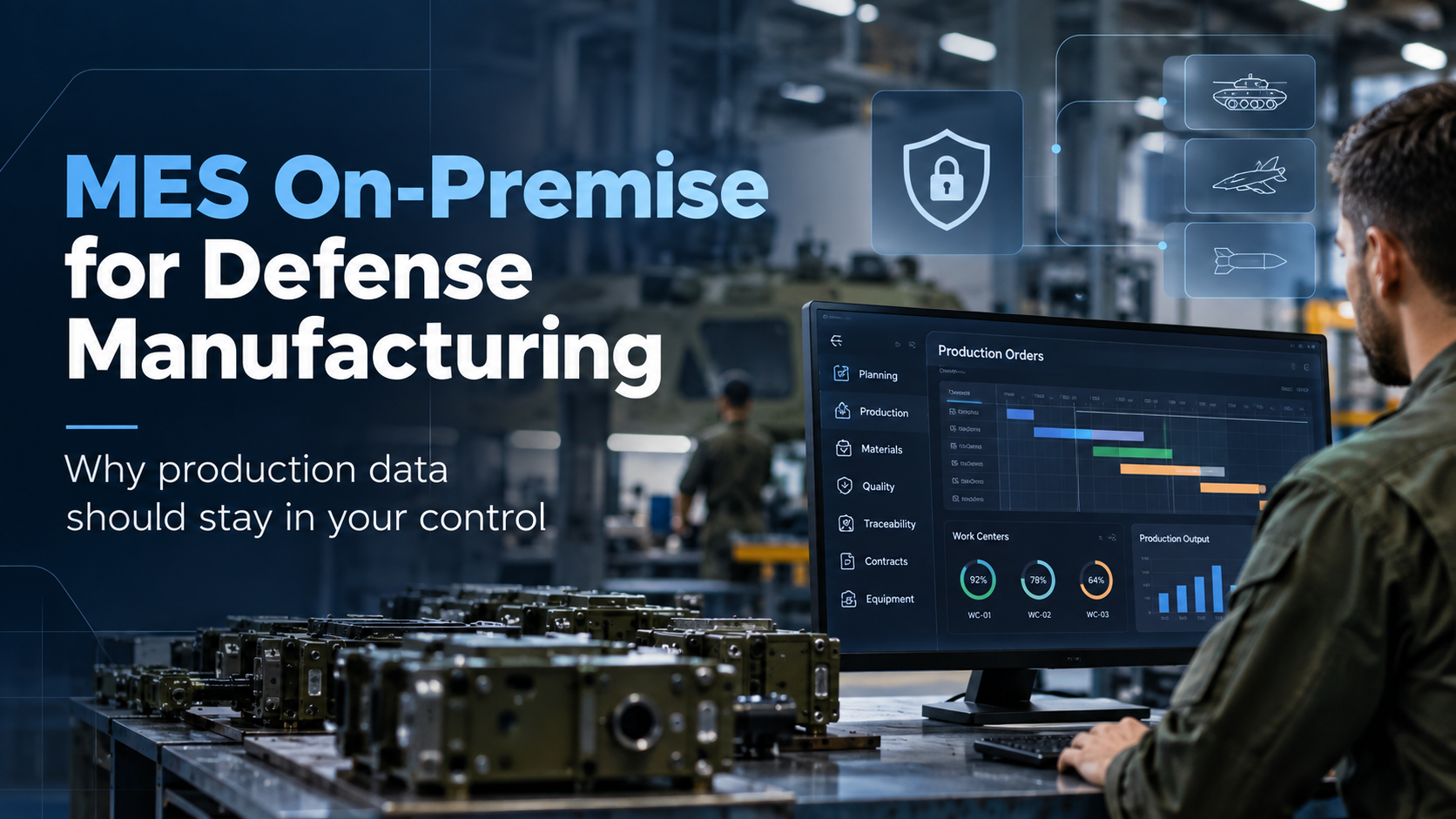
CRMMES on-premise for defense manufacturing: why data must remain within your perimeter
For defense manufacturing, MES is not just a planning system. It stores specifications, production tasks, data on materials and batches, serial numbers, quality control results, contract documents, and shipping information.
Sales & CRM automation
Pipeline, customers, operations and analytics driven by processes, not spreadsheets.
Therefore, alongside MES functionality, a critical question arises: where is production data stored and who has access to it?
Syntech Manufacturing for defense manufacturing can operate on-premise or in a private cloud, as decided by the enterprise. The production environment is deployed within the customer's perimeter and does not require external services to function.
What MES on-premise means
MES on-premise is a model where the manufacturing execution system operates within the enterprise's own infrastructure.
For a defense manufacturer, this is especially important because MES handles data on:
product specifications and revisions;
production routes and orders;
materials, batches, and warehouse balances;
serial numbers;
quality control;
contracts and delivery times;
military acceptance;
export licenses and end-users.
Syntech Manufacturing integrates this data within a single perimeter — from specification and production task to serial number, acceptance certificate, and shipment.
Why a closed perimeter is important for defense manufacturing
The problem arises not only when data is missing. Often, it exists but is located in various places: in the planner's spreadsheet, the designer's email, warehouse documents, or separate folders.
When it's necessary to confirm the history of a specific batch or product, information has to be collected manually.
In Syntech Manufacturing, data is captured directly where it originates: during material receipt, production operation, quality inspection, certificate processing, or product issuance.
Traceability from component to finished product
For defense manufacturing, it is important to know not only what was manufactured, but also from what, when, for whom, and what inspections the product underwent.
Syntech Manufacturing supports end-to-end traceability of batches and serial numbers.
From a serial number, one can trace back to component batches and supplier certificates, and in the other direction — to the customer, contract, and acceptance certificate. An electronic dossier with related documents can also be generated for the product.
The system also covers military acceptance: certificates can be linked to batches, shipments, and specific serial numbers.
Who sees data within the system
On-premise does not mean that all users get access to everything.
Syntech Manufacturing uses Creatio platform mechanisms: row- and column-level permissions, change logs, SSO, and two-factor authentication.
Access can also be isolated by contracts and projects. For example, permissions for a contract, order, or product are configured according to the user's role.
Does on-premise mean automatic compliance with security requirements?
No. The on-premise deployment itself does not automatically make the system compliant with security requirements. Here it is important to distinguish between the certification of the platform, the cloud infrastructure, and the customer's own environment.
Certificates: what they cover and what they don't
Vendor-certified
ISO/IEC 27001:2022 covers the development and support of a no-code platform for process automation and CRM. Bureau Veritas UK.ISMS.287 certificate is valid until 08.06.2028.
ISO 9001:2015 covers software development, customization of automated systems, Creatio cloud service, and customer support. TÜV NORD certificate is valid until 15.04.2028.
This confirms that platform versions are released within audited management systems.
Certified for the vendor's cloud
SOC 2 Type II — independent annual audit of Creatio Cloud controls, including DR and BCP procedures.
ISO/IEC 27017 and ISO/IEC 27018 relate to cloud service security and personal data protection in the cloud.
For on-premise, the enterprise infrastructure is outside this scope: vendor cloud certification does not extend to it.
Capabilities, not certificates
Creatio also has built-in capabilities for working with GDPR requirements, HIPAA medical data protection mechanisms, and accessibility features compliant with WCAG 2.0–2.2 AA, Section 508, and EN 301 549. These are platform capabilities, not separate compliance certificates for a specific customer system.
Important
A vendor certificate does not automatically make your system compliant. It can be part of the evidence base during system evaluation, but the evaluation itself is conducted by its owner.
Creatio cloud infrastructure certification also does not automatically extend to the customer's on-premise infrastructure.
Similarly, it is important not to confuse platform certificates with the certification of the solution itself: Syntech Manufacturing does not have separate certification. The product is created to meet the requirements of Ukrainian defense manufacturing, but this does not mean it is certified according to these requirements.
What a defense manufacturer gets
Syntech Manufacturing allows building a connected digital chain:
contract → specification → production order → materials → operations → quality control → serial number → military acceptance → shipment.
The enterprise determines where the production environment will operate: on-premise or in a private cloud.
Syntech Manufacturing is an MES/MRP solution on the Creatio platform. The product covers planning and MRP, shop floor, warehouse, procurement, quality, traceability, technological preparation, contracts and military acceptance, export control, equipment, and personnel.
Test the system on your own production scenario
During a personal demo, you can go through your scenario — from the delivery schedule and production order to the serial number, acceptance certificate, and license verification — and separately discuss system deployment requirements within your perimeter.
Next step
Get a 30-minute automation assessment
15–30 minutes, no slide decks: we show the solution on your data and tell you if it fits.