
 CRM
How to Choose a MES/MRP Integrator for MilTech Manufacturing: 7 Criteria and a Shortlist
How to choose an integrator for implementing an MRP system in MilTech manufacturing? Check seven criteria: experience with manufacturing processes, support for BOM and revisions, material and capacity planning, traceability and quality control, integrations, data security, as well as launch speed and support. After that, create a shortlist of 3–5 candidates and ask each to demonstrate the exact same manufacturing scenario during a demo.
Sales & CRM automation
Pipeline, customers, operations and analytics driven by processes, not spreadsheets.
For a manufacturer of UAVs, electronics, or other defense equipment, a mistake in selecting an integrator can cost significantly more than an IT project delay.
An incorrect BOM revision, component shortages, unaccounted-for manufacturing operations, or the absence of serial product history can directly impact order fulfillment.
That is why it is important to evaluate not only the functionality of the MES/MRP system, but also the team responsible for its implementation.
MES, MRP, and the Integrator: What Exactly Needs to Be Chosen?
MRP (Material Requirements Planning) is responsible for planning material needs: which components are required, in what quantity, and by what deadline.
MES (Manufacturing Execution System) helps manage the execution of shop floor operations, capture actual results, control quality, and track production processes.
The MES/MRP integrator analyzes company processes, configures the system, organizes integrations, data migration, training, and launch.
These are three distinct components of a single project.
For example, SYNTECH Manufacturing combines MES/MRP functionality on the Creatio platform: production orders, planning, inventory, operations, quality, and traceability.
However, even an out-of-the-box solution requires verifying alignment with the enterprise's specific processes.
7 Criteria for Choosing a MES/MRP Integrator for MilTech
1. Experience with Real Manufacturing Processes
Experience implementing ERP or CRM does not yet mean that the team understands manufacturing specifics.
The integrator must be proficient in routing sheets, production orders, assembly operations, warehouse operations, and quality control.
For defense manufacturing, documentation requirements, serial tracking, and traceability are additionally critical.
Ask them to demonstrate a complete scenario: from receiving a production order to executing operations and transferring the finished product.
What to ask the integrator?
“Can you demonstrate our typical manufacturing process, rather than just system features?”
At SYNTECH, there is a dedicated defense manufacturing automation track for such scenarios.
2. BOM, Revisions, and Change Management
For manufacturers of complex equipment, the Bill of Materials (BOM) is the foundation of planning.
However, simply storing a list of components is not enough.
It is important to know:
Which BOM revision is used in the production order.
How the system handles component substitutions.
Whether change history is maintained.
How changes are handed off from R&D to manufacturing.
For example, if an engineer replaces a component after a batch is launched, the system should allow controlling the application of the new revision according to an approved process.
What to ask the integrator?
“How does the system determine which units were manufactured under the old vs. the new revision?”
You can verify how BOMs and production orders are managed during a SYNTECH Manufacturing demonstration.
3. Material and Capacity Planning
A production plan can look perfect on paper, but fail due to component shortages or work center bottlenecks.
Therefore, the integrator must demonstrate how the system links:
Demand and production orders.
Material inventory.
Procurement needs.
Production routings.
Available capacity and deadlines.
Visual planning tools deserve separate evaluation.
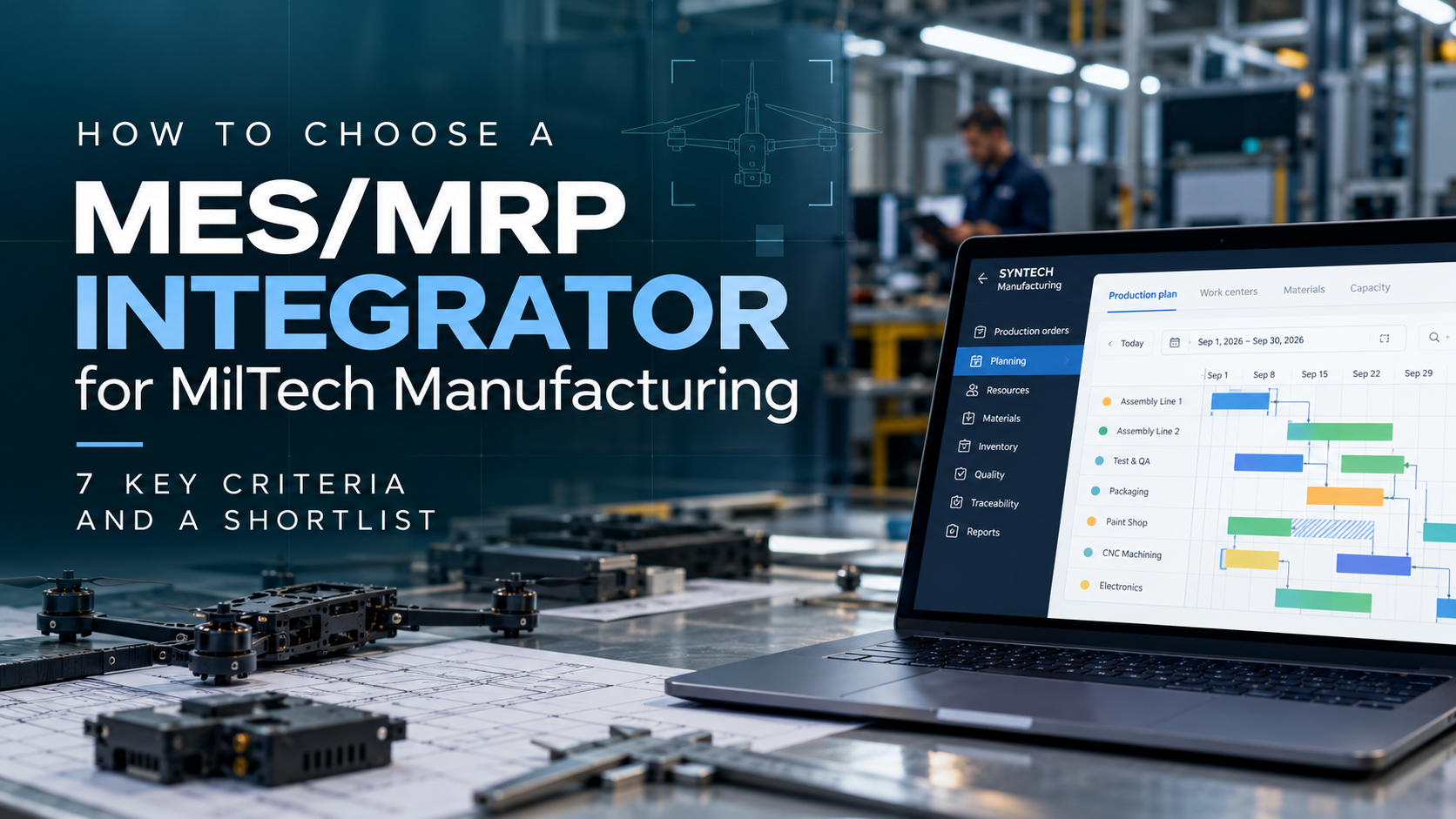
In SYNTECH Manufacturing, scheduling manufacturing operations by work centers on a Gantt chart is available.
For other processes on the Creatio platform, you can use the standalone component Syntech Gantt View for Creatio, which supports timelines, dependencies, and resource scheduling.
These are different solutions, so when choosing, it is worth clarifying which one is applied in your manufacturing scenario.
What to ask the integrator?
“Will the system show material shortages before a production order is launched, and how will the plan adjust if one work center becomes unavailable?”
4. Traceability and Quality Control
For MilTech manufacturing, knowing that a product is completed is not enough.
You must be able to establish:
Which components and material batches were used.
Which operations were performed by personnel.
What inspection results were obtained.
Whether any non-conformities occurred.
Which order or shipment the product belongs to.
This is especially critical for manufacturing UAVs, electronics, and complex equipment requiring batch and serial tracking.
What to ask the integrator?
“How do we find all products that used a specific batch of a component?”
During the demo, ask to trace a component's journey from warehouse receipt to the finished product.
Learn more about this scenario on the SYNTECH Manufacturing for Defense Manufacturers page.
5. Integrations with ERP, CRM, and Warehouse Systems
Not every enterprise is ready to replace its entire IT infrastructure.
Part of financial accounting may remain in an ERP, commercial processes in a CRM, and engineering design documentation in dedicated tools.
Therefore, the integrator must explain which systems need to be connected and what data will be exchanged between them.
Pay special attention to material catalogs, production orders, stock balances, execution statuses, and documents.
What to ask the integrator?
“Which of our systems will remain, how will they exchange data, and who will be responsible for data consistency?”
6. Manufacturing Data Security
For a MilTech enterprise, security must be a qualifying requirement, not an add-on option evaluated after choosing the system.
Check:
Where the data will be hosted.
Whether the required deployment model is supported.
How access permissions are configured.
Who has access to production documentation.
How backups and activity audit trails are organized.
How the integrator's team will obtain access during support.
If the enterprise requires its own secure perimeter, this must be established before finalizing the architecture.
What to ask the integrator?
“What deployment model do you offer, how are access permissions segregated, and what security measures are documented?”
You can review the features of the defense edition on the SYNTECH Manufacturing Defence page.
7. Realistic First Launch and Support
One of the implementation risks is attempting to automate all manufacturing processes at once.
The first stage should be scoped tightly enough for the team to validate the results.
For example, this could be scheduling a single production section, material tracking for a specific product category, or traceability for a single production line.
The integrator must define the initial go-live scope, required data, responsible parties, acceptance criteria, and a subsequent scaling roadmap.
What to ask the integrator?
“Which process will we launch first, how will we verify the outcome, and who will support it after go-live?”
MES/MRP Integrator Shortlist: How to Build It
A shortlist is a list of candidates that potentially meet your company's requirements.
To start, selecting 3–5 integrators who are ready to prove relevant experience and demonstrate a hands-on scenario is sufficient.
How to Compare Candidates
Step 1. Define critical requirements.
Describe what the system must support: BOM, revisions, MRP, serial tracking, quality control, integrations, and security.
Step 2. Prepare an identical demo scenario.
For example, there is a production order for a batch of electronic devices. One component has a revision update, and another is running short in the warehouse.
Ask each candidate to show how the system determines demand, generates a plan, logs manufacturing operations, and ensures traceability.
Step 3. Evaluate results.
For each of the seven criteria, assign a score from 0 to 5:
0 — capability not verified.
1–2 — described or partially implemented.
3 — functional scenario demonstrated.
4 — solution meets most requirements.
5 — scenario proven by live demo and necessary documentation.
The maximum total across all seven criteria is 35 points.
At the same time, critical requirements such as security or traceability must remain mandatory regardless of the overall score.
Step 4. Record decisions in the shortlist.
Record candidate names, scores, strengths, limitations, estimated scope of the first launch, and questions that need clarification.
This approach helps select an integrator based on proven criteria rather than the number of slides in a presentation.
MES/MRP Implementation Speed: How to Estimate Timelines
“We will implement MES in a month.”
Such promises sound appealing, but say nothing on their own about the scope of work.
Speed depends on the number of processes, data readiness, integrations, security requirements, and the scope of the first go-live.
It is important to distinguish four stages.
Demonstration. The vendor showcases the system on a manufacturing scenario.
Pilot. The team tests a scoped process on a defined dataset.
First Go-Live. Users begin working in production within the agreed functionality.
Scaling. New manufacturing units, modules, users, and integrations are added.
Therefore, instead of asking “How long does full implementation take?”, ask:
“What exactly will be operational after the first phase, how long will it take, and what resources will be required from our team?”
A realistic plan with clear boundaries for the first launch is far more valuable than a generic promise to deliver everything in a short timeframe.
How SYNTECH Approaches MES/MRP Implementation for MilTech
SYNTECH Digital develops and implements SYNTECH Manufacturing — an MES/MRP solution built on the Creatio platform.
The system brings together demand and scheduling, shop floor operations, warehouse management, quality control, contracts, and shipping.
For defense manufacturing, a dedicated functional framework is provided covering government contract requirements, acceptance inspections, documentation, and traceability.
Instead of demonstrating dozens of unrelated features, we suggest validating the system on a specific manufacturing workflow.
For example:
Create a production order.
Verify the BOM and material requirements.
Build an operations schedule.
Record execution.
Review quality control results.
Trace used components and the finished product.
This makes it possible to have a concrete discussion about which features already meet the enterprise's requirements, which require customization, and which fall outside the standard solution.
Learn more about the product's capabilities:
SYNTECH Manufacturing — MES/MRP on Creatio
SYNTECH Manufacturing for Defense Manufacturers
Conclusion: Choose an Integrator Based on Demo Results
MES/MRP is not merely a system for production accounting.
It is a way to connect materials, BOMs, manufacturing operations, quality, and finished goods data.
Therefore, the decision to select an integrator should not be made solely based on licensing costs or a generic functional presentation.
Seven criteria and an identical demo scenario will help evaluate integrators' capabilities, compare their approaches, and select the solution that matches your manufacturing needs.
Evaluate the SYNTECH Approach on Your Manufacturing Process
Planning an MES/MRP implementation for MilTech manufacturing?
Show us your scenario: a production order, BOM, materials, or quality control process.
During the demo, we will explore how these processes can be organized in SYNTECH Manufacturing, what integrations are required, and where it makes sense to start.
Next step
Get a 30-minute automation assessment
15–30 minutes, no slide decks: we show the solution on your data and tell you if it fits.