
 CRM
MES for MilTech Manufacturing in 2026: How to Choose Syntech Manufacturing
Ukrainian MilTech manufacturing in 2026 operates under high product variability, frequent design changes, and strict requirements for serial numbers, batches, quality, and traceability.
Sales & CRM automation
Pipeline, customers, operations and analytics driven by processes, not spreadsheets.
For manufacturers of drones, electronics, ground systems, equipment, and components, it is not enough to simply know how much product needs to be made. You need to see which exact product revision is being assembled, from which components, at which work center, who performed the operations, which inspections were passed, and when the order will be ready.
This is exactly where an MES — Manufacturing Execution System — is needed. It creates a digital loop between production planning and actual shop-floor execution: helping to manage production tasks, resources, materials, quality, and traceability.
What to look for when choosing an MES in 2026
1. Traceability and genealogy
For MilTech, knowing only the finished product's serial number is not enough.
The system must store the production history: serial numbers, component batches, BOM revisions, completed operations, operators, and inspection results.
This makes it possible to quickly answer the key questions:
which BOM revision was used;
which component batches a specific unit was built from;
who performed the operations;
which inspections it passed;
where a specific batch or serialized unit was shipped.
For manufacturers with high quality-control requirements, this kind of traceability is one of the key MES selection criteria.
2. Revision and change management
In MilTech, a product's design can change very quickly.
So it is worth checking how the MES supports BOM and routing revision management and engineering change control, so that production always uses the current product version.
In particular:
bills of materials and their revisions;
technological routings;
work instructions;
design changes;
data currency directly on the shop floor.
This helps reduce the risk of a situation where the design documentation has already changed while the shop floor keeps working with the old version.
3. Production planning and replanning
The production plan must account for the real load on equipment and work centers.
An MES should make it possible to see the production schedule, dependencies between operations, available capacity, and changes to deadlines.
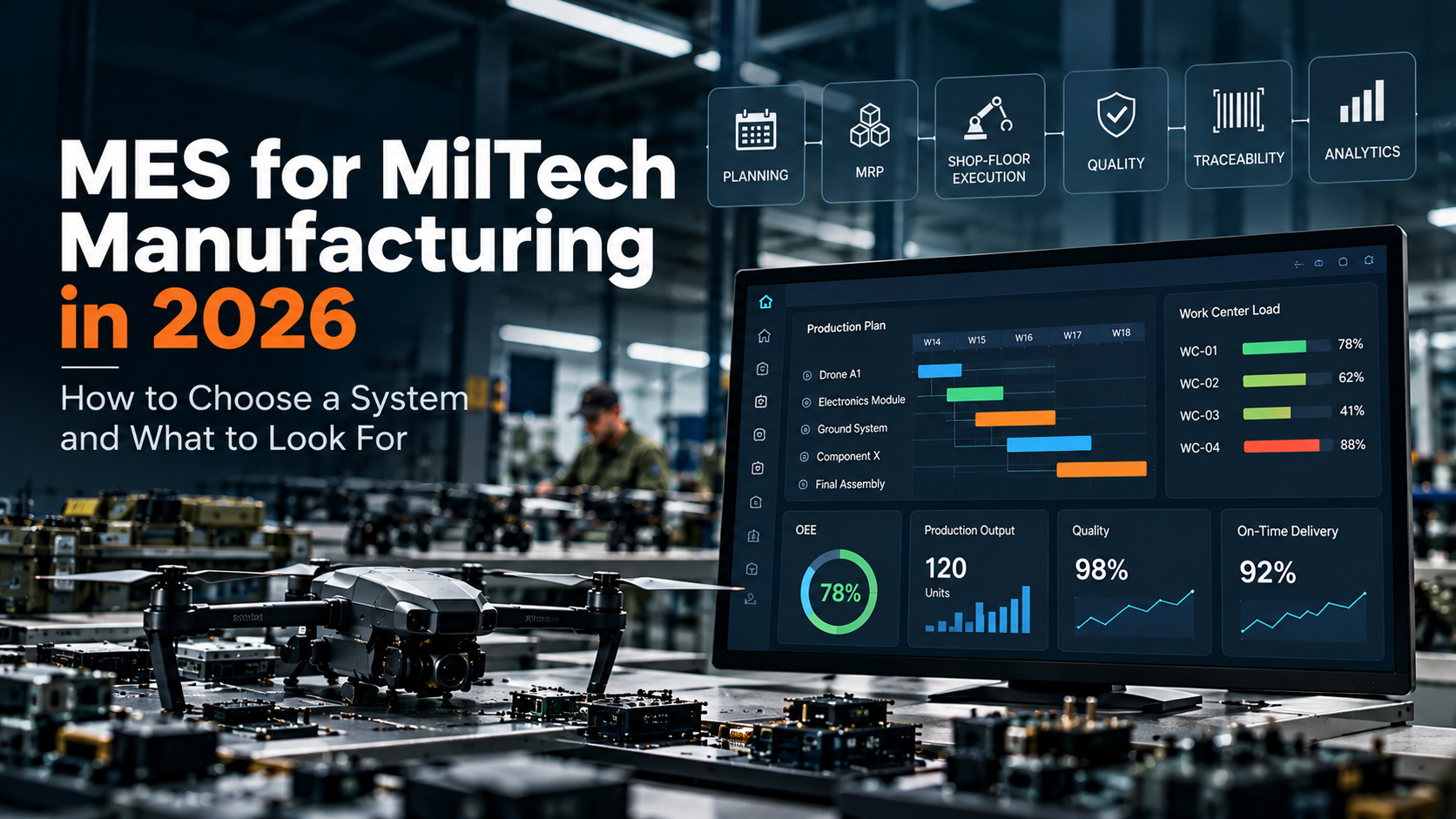
Syntech Manufacturing uses a Gantt chart for this, showing operations by work center, dependencies, statuses, and load. The system also supports auto-scheduling.
4. Shop-floor execution
An MES must work not only for the planner or the production manager.
The operator needs a clear workplace where they can see their tasks and record operation completion directly while working.
It is important that operation execution is linked to the production order, materials, work center, operator, and actual production results.
This allows production actuals to come directly from the production process, instead of being collected manually after the shift ends.
5. MRP, BOM, and warehouse
For complex manufacturing, the MES must be connected to materials planning.
It is worth checking:
support for multi-level BOMs;
material requirements calculation;
connection to the production plan;
generation of purchasing needs;
control of warehouse balances;
batch and serial accounting;
reservation and movement of materials.
The more complex the product and the more BOM levels, the more important it is to have a single source of up-to-date data instead of separate files for planning, warehouse, and production.
6. Quality
For MilTech, quality control must be integrated directly into production processes.
When evaluating an MES, pay attention to support for:
incoming inspection;
in-process inspection;
final acceptance;
nonconformances;
CAPA;
8D;
product blocking and recall;
metrology and calibration.
This way the manufacturer gets not only information about what was produced, but also a history of which inspections a specific unit went through.
7. OEE and production analytics
A production manager needs more than a list of open orders.
They need a picture of what is really happening on the shop floor: work center load, productivity, quality, plan execution, and deviations.
When choosing an MES, check for:
OEE;
FPY;
work center monitoring;
production dashboards;
plan/actual control;
quality indicators;
production order execution analytics.
8. ATP/CTP and answering "When will it be ready?"
For a manufacturer, it is important to connect sales with real production capabilities.
ATP/CTP makes it possible to assess product and capacity availability before confirming deadlines to a customer.
Such a calculation can use data on available stock, production capacity, supply lead times, and the current production plan.
9. Integration and adaptability
An MES should not create yet another isolated information silo.
It must be connected to orders, warehouse, purchasing, quality, and other business processes.
For manufacturers whose processes change, it is also important to check how easily the system can be adapted.
Low-code tools can allow administrators to change fields, pages, business processes, permissions, and reports according to the enterprise's needs.
10. Security and access control
For MilTech, this is a separate criterion.
It is worth checking:
role-based access model;
action auditing;
user permission control;
the ability to deploy within the required IT perimeter;
available cloud or on-premise deployment options.
What to check separately for defence manufacturing
For defence manufacturing, it is worth separately checking support for processes related to:
military acceptance;
government contracts;
the electronic product dossier;
serial and batch traceability;
NATO codification — NSN, NIIN, NCAGE;
export control;
product blocking and recall;
quality management;
CAPA and 8D;
metrology and calibration.
These capabilities are especially important where you need not just to manufacture a product, but to have a controlled history of its configuration, components, operations, and inspection results.
Syntech Manufacturing — MES/MRP on the Creatio platform
Syntech Manufacturing is an MES/MRP on the Creatio platform that brings together demand and planning, production, warehouse, quality, contracts, and shipping in a single database.
The system works with BOMs and routings under revision control, production orders, materials, work centers, batches and serial numbers, quality control, and product history.
Production planning and MRP
The production plan is linked to material requirements, BOMs, stock, and open deliveries.
Based on planning, the system allows you to work with production orders and purchasing needs.
The Gantt chart shows operations by work center, dependencies, statuses, and load, helping to control the production plan and react to changes.
Working directly on the shop floor
Operators work with production tasks through their workplaces.
The system supports shift assignments, scanning, Andon signals, time tracking, and work center monitoring.
Actual operation execution is recorded in the system and linked to the production order, materials, work center, and operator.
For warehouse and production processes, automatic material write-off is also provided.
Serial and batch traceability
By serial number you can trace:
the BOM revision;
the component batches used;
supplier certificates;
completed operations;
operators;
inspection results;
acceptance;
shipping.
Search also works in reverse: from a specific component batch you can jump to the units in which it was used.
This helps with nonconformance investigations, product blocking, and recalls.
An electronic dossier with the production history and related documents can also be generated for a product.
Quality management
Quality control is integrated with production processes and traceability.
The system supports working with nonconformances, CAPA, and 8D, and inspection results can remain part of a specific unit's history.
Monitoring and analytics
Syntech Manufacturing allows you to control the state of production through production indicators and dashboards.
Among the available indicators and control scenarios are OEE, FPY, work center monitoring, production plan execution, and quality indicators.
Defence perimeter
For defence manufacturing, Syntech Manufacturing supports processes related to:
government contracts;
military acceptance;
NATO codification — NSN, NIIN, NCAGE;
export control;
the electronic product dossier;
serial and batch traceability;
blocking and recall;
metrology and calibration control.
A single Creatio platform
Syntech Manufacturing runs on the Creatio platform, which makes it possible to combine production processes with the company's other data and processes.
Creatio's low-code capabilities allow administrators to adapt fields, business processes, pages, permissions, and reports to the enterprise's needs.
For companies with corresponding IT perimeter requirements, on-premise and private cloud deployment options are available.
How to choose an MES in practice
1. Define your must-have requirements
Record the required level of traceability, BOM structure, revision frequency, number of work centers, quality processes, warehouse accounting, and the need for MRP.
2. Test the system on a real scenario
Ask to see not just a product presentation, but a process typical for your enterprise:
order → BOM → planning → materials → production → inspection → serial number → shipping.
3. Model a design change
Check what happens if the BOM or the technological routing changes after production has started.
It is especially important to see how the system works with revisions and already open production orders.
4. Test traceability
Take a sample serial number and ask to see the full product history.
Then do the opposite: pick a component batch and check whether you can find the units in which it was used.
5. Test the operator's work
An MES may look convenient on a manager's dashboard, but operators will work with the system every day.
So separately test shop-floor scenarios: receiving a task, performing an operation, scanning, recording time, materials, and results.
6. Assess the total cost of ownership
Consider not only the MES license, but also the platform, implementation, integrations, training, support, and future system changes.
7. Test the system on a controlled perimeter
Before scaling, the solution can be tested on a separate production area or a specific process, evaluating how it works with your real data and scenarios.
Conclusion
For MilTech manufacturing, an MES in 2026 is not just a digital production plan.
The system must connect BOMs and their revisions, materials, production operations, work centers, serial numbers, quality, and shipping into a single traceable process.
When choosing a solution, look not at the number of features in a presentation, but at whether the system can answer specific production questions:
What are we producing right now?
Which revision?
From which components?
Who performed the operations?
Which inspections were passed?
Where did the deviation occur?
When will the order be ready?
These are exactly the scenarios worth testing during a demo.
Syntech Manufacturing brings together planning, MRP, production execution, warehouse, traceability, quality control, and processes relevant to defence manufacturing on the Creatio platform.
Next step
Get a 30-minute automation assessment
15–30 minutes, no slide decks: we show the solution on your data and tell you if it fits.