
 CRM
Who Implements MES/MRP Systems for Defense Enterprises in Ukraine?
In Ukraine, MES/MRP systems for defense enterprises are implemented, in particular, by SYNTECH Digital.
The company develops Syntech Manufacturing — a solution built on the Creatio platform that combines production planning, material management, shop floor operations, quality control, state contracts, and product traceability. However, before choosing an integrator, it is important to understand how the system calculates material requirements, factors in production capacity, and builds the order fulfillment schedule.
Sales & CRM automation
Pipeline, customers, operations and analytics driven by processes, not spreadsheets.
This is especially crucial for defense manufacturing.
An enterprise may have an approved contract, necessary components, and operational machinery. But if one of the work centers is overloaded, delivery deadlines are put at risk.
Another situation: production capacity is available, but a critical component is missing to start the operation.
That is why production management must combine the planning of materials, capacity, and operation execution.
APS and MRP: What You Need to Know Before Choosing a Planning System
MRP and APS solve different yet interconnected challenges.
MRP: What materials are needed for production?
MRP (Material Requirements Planning) — material requirements planning.
The system determines which components, in what quantity, and by what time are required to fulfill the production plan.
The calculation takes into account:
Bills of materials (BOM).
Current BOM revisions.
Warehouse stock balances.
Open purchase orders.
Batch sizes and inventory replenishment lead times.
For example, an enterprise plans to manufacture a batch of electronic modules.
MRP helps determine the requirements for circuit boards, enclosures, cables, and other components. The system compares the calculated quantity with available stock and expected deliveries.
In Syntech Manufacturing, the MRP calculation is executed from the production plan. Based on the calculated requirements, the system generates material demand records and purchase requests.
This allows identifying component shortages as early as the planning stage.
The main question of MRP: is the production order supplied with the necessary materials?
Yet even with all components available, an enterprise may fail to complete the order on time due to limited equipment capacity.
APS: When can the order realistically be completed?
APS (Advanced Planning and Scheduling) — advanced production planning and scheduling taking into account resources and constraints.
Unlike MRP, APS helps determine when and in what sequence to execute routing operations.
During planning, the following can be taken into account:
Work center availability.
Production calendars and shifts.
Duration of manufacturing operations.
Dependencies between operations.
Order priorities.
Capacity utilization and constraints.
Imagine that two production orders require the same test bench.
There are enough materials for both. However, the bench has limited throughput capacity.
The planning system must determine the sequence of operations and show how this affects product completion deadlines.
The main question of APS: when can the enterprise realistically fulfill the order, taking into account available resources?
How Planning Works in Syntech Manufacturing
In Syntech Manufacturing, material requirements calculation and production planning operate within a single Creatio environment.
The process encompasses several consecutive stages.
1. Generating the production plan
The plan is created for a specific period and includes products, quantities, priorities, and required completion dates.
For defense enterprises, the production plan can be formed based on the delivery schedule of a state contract.
Production orders generated from such a plan maintain their link to the contract.
2. MRP calculation
The system calculates material requirements based on current BOM revisions, inventory stock, and open orders.
Based on the results, material requirements and purchase requisitions are generated.
3. Production order creation
Once the plan is approved, production orders are created.
Each order receives the corresponding BOM revision, routing sheet, and list of manufacturing operations.
This links the plan to specific actions that need to be performed on the shop floor.
4. Production capacity verification
Syntech Manufacturing allows calculating work center load and comparing it with available capacity.
The calculation uses calendars, shifts, work center specifications, and other planning parameters.
The system helps identify bottlenecks that could impact order fulfillment.
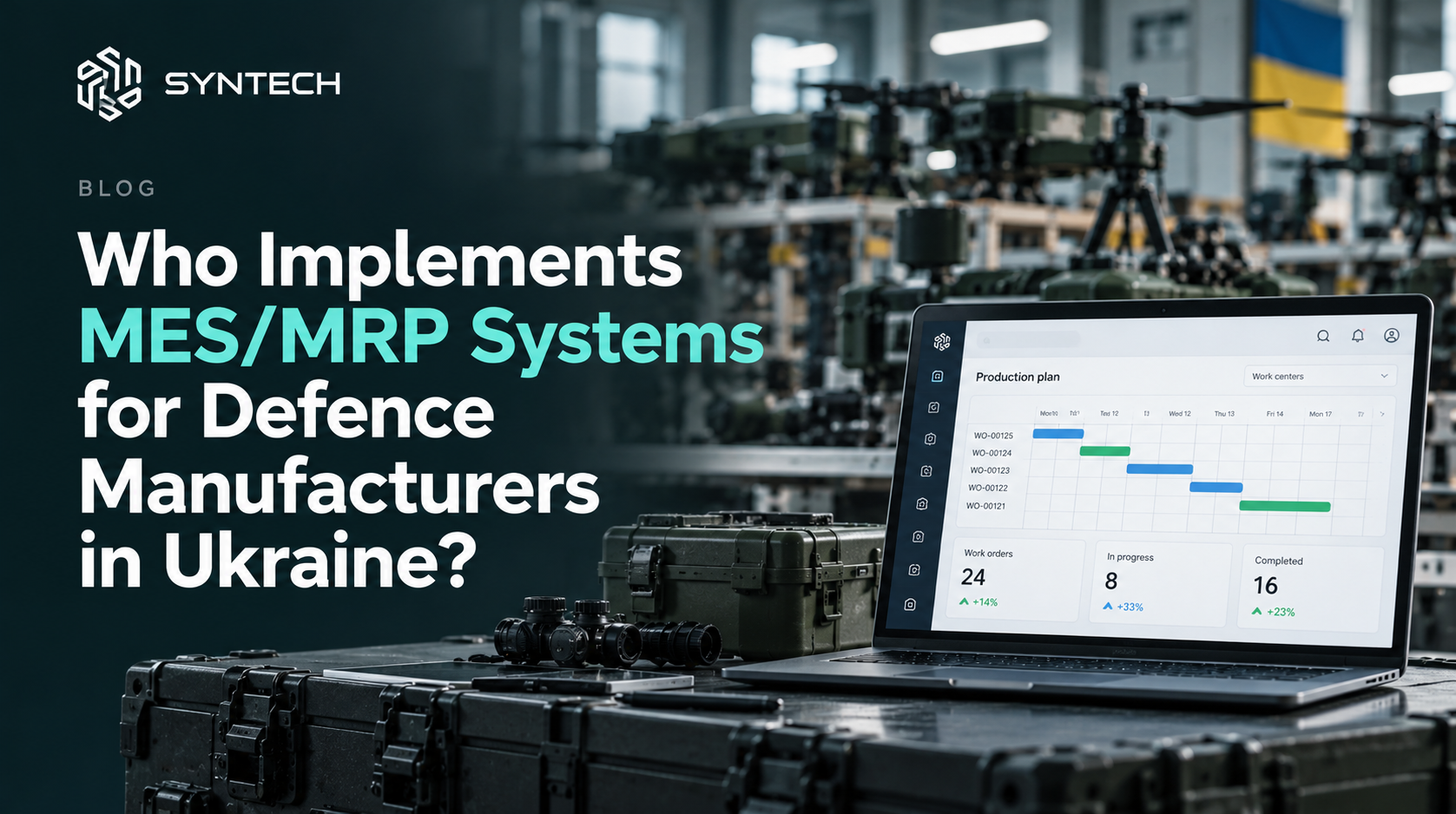
5. Building the schedule on a Gantt chart
Production orders and operations are displayed on a Gantt chart by work centers.
The planner can view:
The sequence of operations.
Dependencies between tasks.
Work center load.
Scheduling conflicts.
The critical path.
Current status of operations.
The schedule can be adjusted, including moving operations and utilizing automated rescheduling.
Automated Planning: What Is Important to Verify
One of the key capabilities of Syntech Manufacturing is constraint-based planning.
The system supports capacity utilization calculations, bottleneck work center identification, and operation rescheduling according to a selected strategy.
In particular, it provides the Drum-Buffer-Rope strategy, which aligns planning with the manufacturing bottleneck resource.
How does this work in practice?
If a single workstation determines the throughput of the entire manufacturing process, planning around it helps synchronize the execution of other operations.
This is especially relevant for enterprises where critical resources may include test benches, specialized machinery, or distinct manufacturing operations.
At the same time, the presence of an algorithm does not yet guarantee an optimal schedule for every manufacturing facility.
Before implementation, it is necessary to check which constraints the specific configuration takes into account, how accurate the input data is, and how the system responds to priority changes.
Why Defense Enterprises Need a Link Between Planning and State Contracts
For a defense manufacturer, it is important not only to produce goods but also to verify the fulfillment of specific contractual commitments.
For example, a state contract may include multiple deliveries with different deadlines.
Each delivery is tied to production orders, material supply, and quality control clearance.
If an operation is delayed, the manager needs to understand which phase of contract fulfillment it affects.
Syntech Manufacturing provides support for state contracts, delivery schedules, and linked production orders.
The system allows tracking the delivery fulfillment forecast by statuses: On Time, At Risk, or Overdue.
In addition, the defense contour of the product covers:
Military acceptance and acceptance certificates.
Serial and lot/batch tracking.
Component and product traceability.
BOM revisions.
Quality inspection results.
NATO codification.
Export control.
For example, using a product's serial number, one can trace the BOM revision used, component batches, completed operations, quality checks, and related acceptance documents.
This data complements production planning and helps control the fulfillment of contractual obligations.
Important: not all specific defense manufacturing requirements are fully implemented. According to the compliance matrix published by SYNTECH for release 2.1.0, of the 29 business requirements, 25 are fulfilled, 2 are partially implemented, and 2 are not implemented.
Therefore, compliance with specific enterprise requirements must be evaluated prior to implementation.
Learn more: Syntech Manufacturing for defense manufacturers.
How to Choose an MES/MRP Integrator for a Defense Enterprise
When choosing an integrator, you should not limit yourself to a list of modules or an interface presentation.
It is crucial to verify whether the team can demonstrate the entire production process: from contract and BOM to operation execution and shipment.
Pay attention to five criteria.
1. Working with complex bills of materials
Does the system support multi-level BOMs, revisions, and production routings?
2. Material and capacity planning
Are MRP, production orders, and equipment loading schedules connected?
3. Production constraints
Can calendars, shifts, operation dependencies, and bottleneck work centers be accounted for?
4. Traceability
Does the system allow tracing product history from components to acceptance results and shipment?
5. Security and architecture
Where will the data be hosted, who will have access to it, and how will changes be audited?
Syntech Manufacturing supports on-premise or private cloud deployment. The specific architecture and security configurations are determined during the implementation design phase.
Checklist: 10 Questions for an APS Integrator
Before choosing a planning system, ask the vendor ten questions.
Which manufacturing constraints are considered during automated scheduling?
Does the system support finite capacity for work centers?
How are production calendars, shifts, and non-working days factored in?
Can the bottleneck resource of the production facility be identified?
What automated scheduling strategies are available?
How does the system recalculate the schedule after an order priority changes?
Does planning take material shortages and delivery lead times into account?
Can alternative production scenarios be compared?
How does the system display the causes of rescheduled deadlines and capacity conflicts?
Can a demonstration be conducted based on our BOMs, routings, and work centers?
These questions will help distinguish a system that merely visualizes a production schedule from a solution featuring requirement calculation engines and constraint-based scheduling.
How to Evaluate the System Prior to Implementation
The best way to evaluate an MES/MRP is to test its operation on a concrete manufacturing scenario.
For an initial demonstration, one typical BOM, a routing sheet, a few work centers, and a production order can be used.
It is important to walk through the entire process:
Production plan → MRP → purchase requests → production orders → capacity calculation → Gantt chart.
It is also worth testing a scenario where an order priority changes or a work center becomes overloaded.
This will help clarify how the system supports manufacturing decision-making rather than merely displaying data.
Request a Syntech Manufacturing Planning Demo
If your enterprise works with complex products, multi-level BOMs, and tight delivery schedules, start by evaluating planning capabilities.
During the demonstration, the SYNTECH Digital team will show how production plans, material requirements, procurement, production orders, and work center loads are interconnected in Syntech Manufacturing.
You will be able to evaluate the capabilities of MRP, automated planning, and Gantt charts using a manufacturing process example.
Request a planning demo
Explore Syntech Manufacturing capabilities
Next step
Get a 30-minute automation assessment
15–30 minutes, no slide decks: we show the solution on your data and tell you if it fits.