
 CRM
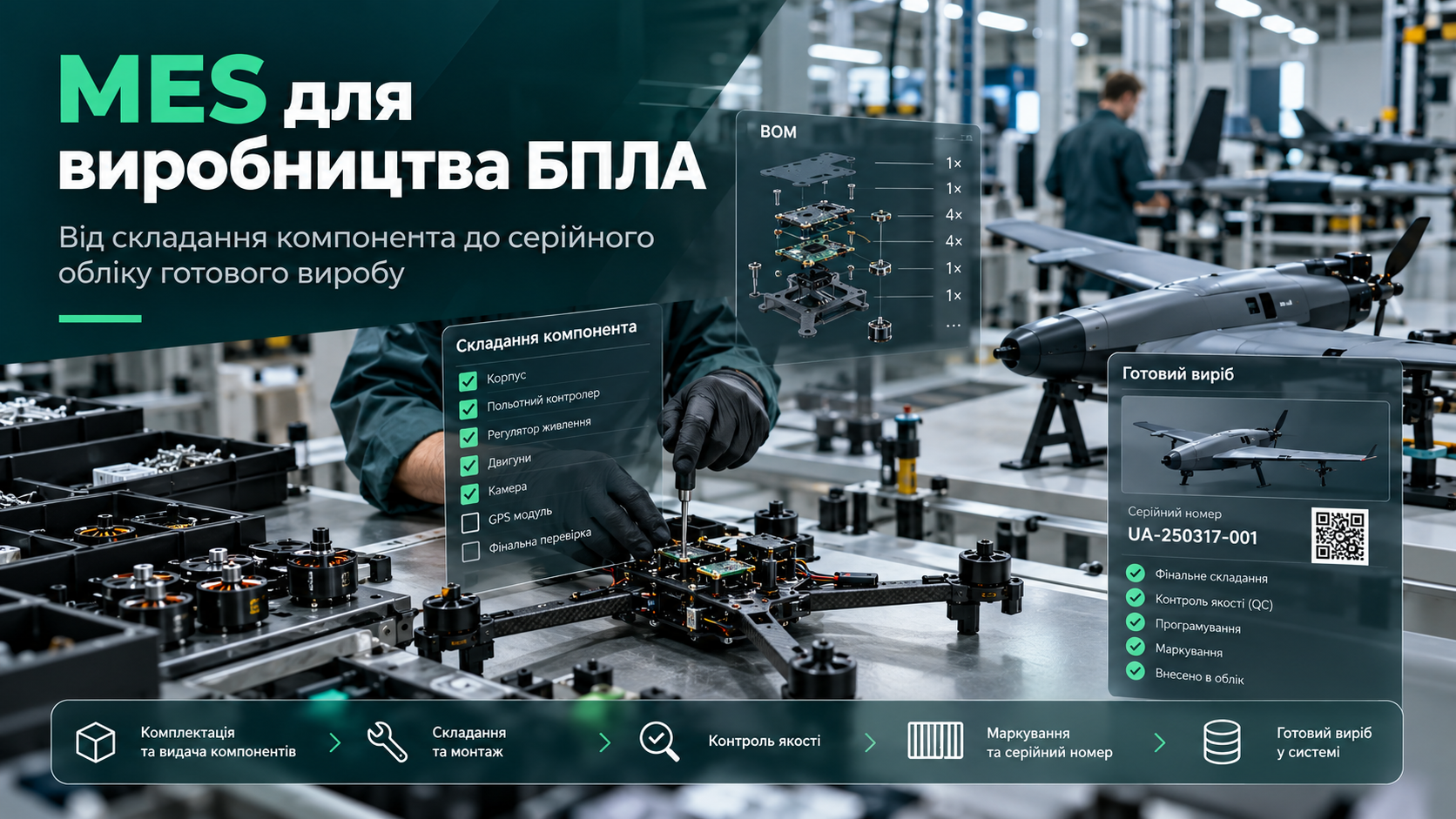
CRMMES for UAV production: assembly, quality, and serial accounting
The production of unmanned aerial vehicles requires control at every stage: from the procurement of electronic components and assembly of units to quality inspection, serial number assignment, and shipment of the finished product.
Sales & CRM automation
Pipeline, customers, operations and analytics driven by processes, not spreadsheets.
When production scales, Excel accounting, paper routing cards, and separate warehouse spreadsheets become insufficient. Information about components, production operations, and inspection results remains in different sources.
Because of this, even a simple question can require a lengthy search:
What components are installed in a specific UAV, from which batches did they arrive, who performed the assembly, and what inspections did the finished product pass?
An MES system (Manufacturing Execution System) helps solve this problem by connecting production operations, materials, personnel, and quality control in a single digital environment.
Let's consider how MES works for UAV production and what capabilities an enterprise needs to ensure the traceability of every serial product.
What is an MES system for UAV production
MES (Manufacturing Execution System) is a system for managing the execution of production processes that records and controls the actual execution of work in the workshop.
For a UAV manufacturer, MES helps connect the product specification, production order, assembly route, used materials, quality control results, and serial number.
In practice, MES provides:
accounting of production orders and operations;
management of assembly routes;
recording of used materials and batches;
control of work execution;
registration of quality inspections;
serial accounting of finished products;
traceability of components from receipt to shipment.
The main value of MES for a drone manufacturer lies not only in the automation of operations but also in the ability to restore the complete production history of a specific UAV.
1. BOM and specifications: what each UAV consists of
The production process begins with the product specification, or BOM (Bill of Materials).
BOM defines what materials, components, and assemblies are required to manufacture the finished product.
For UAVs, the specification may include electronic boards, motors, controllers, body elements, cable connections, and other components depending on the design.
In production, it is important not just to have a list of parts, but to understand which version of the specification is used for a particular order.
For example, an engineer makes changes to the product design. If technical documentation, warehouse accounting, and the production plan are maintained separately, part of the team may continue to work according to the previous revision.
An MES/MRP solution allows linking specifications, their revisions, and routing cards with production orders.
In Syntech Manufacturing, an MES/MRP system on the Creatio platform, multi-level specifications, routing cards, and revision management are supported. This allows maintaining the connection between the product version and its manufacturing operations.
2. Material planning and preparation for assembly
After the specification is formed, it is necessary to determine if there are enough materials to fulfill the production order.
For a UAV manufacturer, it is important to consider not only the total quantity of components in stock but also materials already reserved for other orders, delivery times, and availability of production capacities.
This is where MES should be combined with MRP (Material Requirements Planning), a system for planning material requirements.
MRP helps determine:
which components are necessary to fulfill the plan;
how many materials are available;
which items are missing;
which purchases need to be planned;
how material shortages can affect production deadlines.
Syntech Manufacturing combines MES and MRP in one environment, linking production planning with procurement, warehouse, and work execution.
This is especially relevant for enterprises that simultaneously manufacture several UAV models or work with different product revisions.
3. Digital UAV assembly route
After securing materials for production, work execution begins.
At this stage, the key document is the routing card, which defines the sequence of operations, work centers, standard time, and execution requirements.
In UAV production, the route may cover component preparation, assembly of individual units, final assembly, inspections, and transfer of the finished product for acceptance.
Without digital accounting, it is difficult for a production manager to quickly find out at what stage a specific order is, what work has been completed, and where a delay has occurred.
MES allows recording the execution of operations and linking them to the production order.
In Syntech Manufacturing, a operator's workstation, shift assignments, and work center monitoring are provided for this purpose.
The employee receives information about the operation, and the system records the production fact.
The manager sees the status of work execution without the need to manually collect reports from different departments.
4. Quality control at every stage of production
For UAV production, it is important to control the quality not only of the finished product but also of materials and intermediate assembly results.
A problem arises when inspection results are stored separately from production orders.
For example, quality control identified a component non-conformance. If the information is not linked to the warehouse batch, the enterprise has to additionally determine where else this component was used.
MES allows organizing control at three levels:
Incoming control. Inspection of materials and components after receipt from the supplier.
Operational control. Inspection of the results of individual production operations.
Final control. Inspection of the finished product before acceptance and shipment.
In Syntech Manufacturing, quality criteria are linked to production operations. The system supports the registration of inspection results, non-conformances, and the generation of test reports.
Materials that are in quarantine due to quality issues are blocked from further release into production.
Thus, quality control becomes part of the production process, not a separate stage of document management.
5. Serial accounting and traceability of the finished UAV
One of the most important processes in drone manufacturing is ensuring traceability.
Traceability means the ability to establish the origin of materials, the history of production operations, and the results of inspections of a specific product.
For a serial UAV, several questions need to be answered:
According to which specification revision was the product manufactured?
Which batches of components were used?
Who performed the production operations?
What quality inspections were conducted?
When was the product accepted and shipped?
In Syntech Manufacturing, data is linked to batches and serial numbers of finished products.
By serial number, one can obtain information about the specification, components, production operations, quality control results, and acceptance documents.
The system also supports labeling of serial products using DataMatrix.
This makes it possible to use the serial number as an access point to the production history of a specific UAV.
6. What happens if a defective batch of components is detected
Let's imagine a production situation.
The enterprise received a batch of electronic components and used it to manufacture several series of UAVs.
After assembly is complete, the supplier reports a potential non-conformance of part of the delivery.
If component accounting is kept in separate tables, the enterprise needs to manually cross-reference invoices, warehouse documents, and production logs to determine the list of products that may be linked to the problematic batch.
With configured MES traceability, it is possible to perform a backward search: from the component batch to the finished products in which it was used.
Syntech Manufacturing provides search by batches and serial numbers in both directions, as well as mechanisms for blocking and recalling products.
This helps determine the extent of the problem and prepare data for further actions by the quality department.
7. How Syntech Manufacturing unifies UAV production into one system
Syntech Manufacturing is an MES/MRP solution on the Creatio platform for managing discrete manufacturing, including the assembly of electronics, equipment, and UAVs.
The system links the main stages of the production cycle:
Specification and revisions → Material planning → Procurement and warehouse → Production operations → Quality control → Serial accounting → Acceptance and shipment.
Unlike a process where data is distributed among Excel, a warehouse program, and separate workshop logs, Syntech Manufacturing uses a common database on the Creatio platform.
For defense manufacturers, the product also provides functionality for working with government contracts, military acceptance documentation, and NATO codification.
The system supports deployment on the enterprise's own infrastructure or in a private cloud.
This allows organizing production accounting in the enterprise's controlled IT environment.
8. How to understand that UAV production needs an MES system
The need for MES usually becomes apparent when an enterprise increases production volumes, the number of orders, and the nomenclature of components.
Signs of the need for digitalization can be:
the production plan is constantly adjusted manually;
the warehouse does not have up-to-date information on workshop needs;
specification revisions are communicated via files and messages;
quality data is stored separately from orders;
the history of a serial product needs to be restored from documents;
the manager does not see the current status of order fulfillment.
Transitioning to MES does not necessarily mean simultaneously restructuring all processes.
It is advisable to start by analyzing the production route, specification structure, and serial accounting requirements. After that, determine which processes need to be digitized first.
Conclusion
For a UAV manufacturer, production digitalization is primarily about creating linked accounting of materials, operations, inspections, and finished products.
An MES system helps transition from disparate documents to a unified production history, where each serial number is linked to data about its manufacture.
Syntech Manufacturing combines MES, MRP, warehouse management, quality control, and serial traceability on the Creatio platform.
This provides the enterprise with tools for managing the production process from component specification to acceptance and shipment of the finished UAV.
Want to see how it works with your production as an example?
Familiarize yourself with the capabilities of Syntech Manufacturing and request a system demonstration for your production scenario.
Next step
Get a 30-minute automation assessment
15–30 minutes, no slide decks: we show the solution on your data and tell you if it fits.