
 CRM
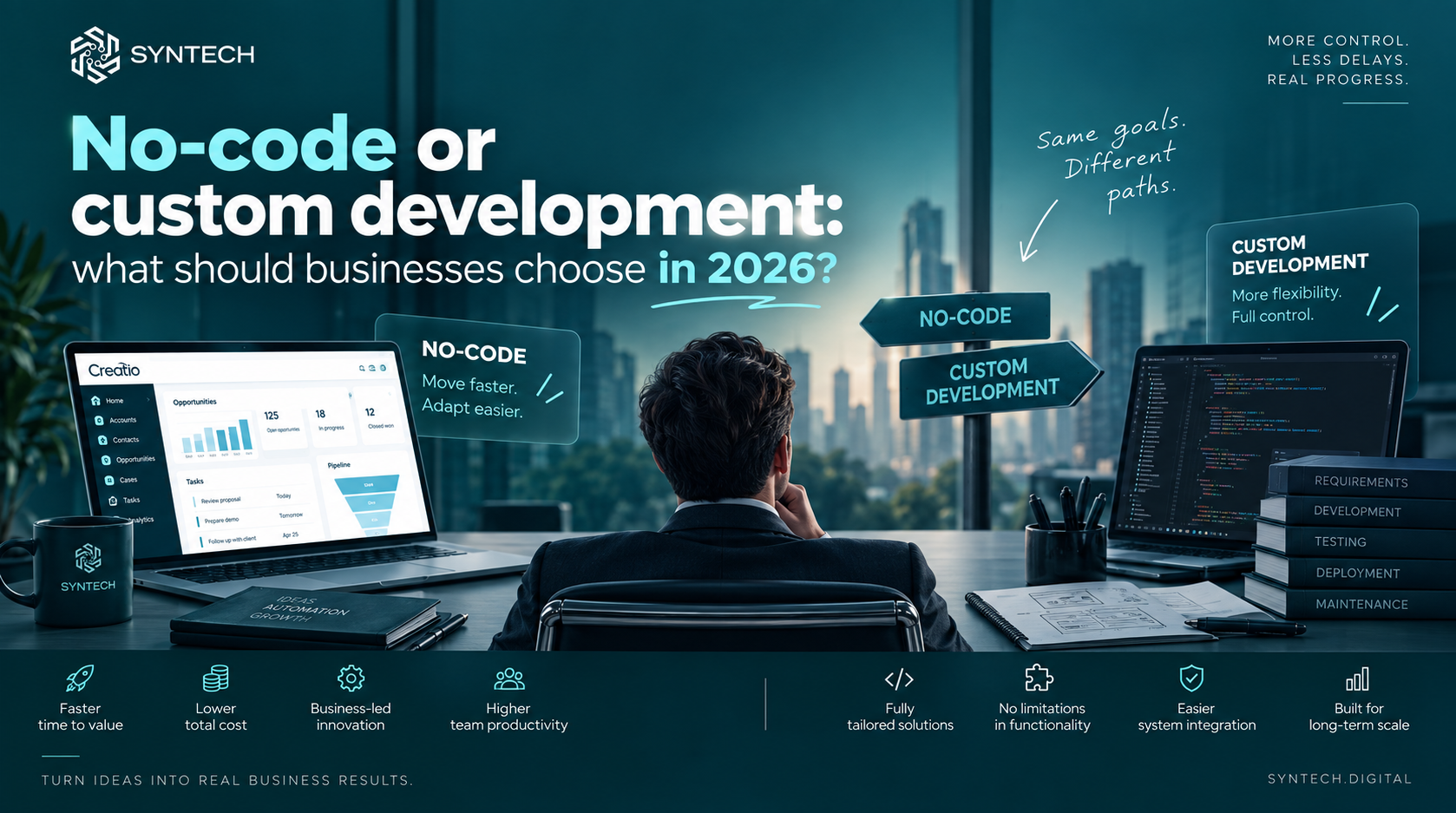
CRMNo-code or custom development: what should businesses choose in 2026?
For years, companies approached digital transformation with a simple assumption: if a business is unique, the software should be written "from scratch" (custom). This was logical ten years ago. Today, approaches have changed dramatically.
Sales & CRM automation
Pipeline, customers, operations and analytics driven by processes, not spreadsheets.
Modern no-code platforms are capable of automating complex corporate processes, integrating disparate systems, managing AI agents, and supporting industry solutions – all without writing thousands of lines of code.
So the real question is not, "No-code or custom development?"
It sounds like this: "Which approach will bring real value to the business faster?"
Why businesses are rethinking their attitude towards custom development
Custom software promises limitless flexibility. However, this flexibility comes at a price. Many organizations underestimate the hidden costs:
- Long development cycles
- Constant changes in business requirements
- Increasing costs for maintenance and support
- Dependence on specific developers
- Complex and risky system updates
- Technical debt accumulating over the years
By the time a company finally gets a ready-made custom solution, business priorities often have already changed – and the developed software instantly becomes obsolete.
Why no-code has become a corporate strategy
Modern no-code platforms have long outgrown the level of simple website builders or internal spreadsheets. Leading corporate platforms, such as Creatio, allow companies to:
- Automate complex end-to-end business processes
- Build scalable CRM and operational systems
- Seamlessly integrate multiple existing systems
- Configure approval routes, regulations, and business rules
- Implement AI automation and intelligent agents
- Continuously adapt systems without rewriting code
Instead of waiting months for every minor change, businesses gain the ability to develop their IT systems at the same speed as operational needs change.
When custom development still makes sense
Custom development has not disappeared, and it remains the right choice for specific tasks:
- Patented algorithms and unique intellectual property
- Specific manufacturing management logic
- Deeply customized customer portals
- Digital products intended for commercial sale (SaaS)
- High-load systems with a unique architecture
In such cases, custom development creates an unquestionable competitive advantage. However, such scenarios are becoming increasingly niche and specific.
Hybrid model as the new standard
Most successful corporate projects no longer choose just one approach. Instead, they combine the best of both worlds.
Modern corporate architecture most often looks like this:
- No-code platform: Manages processes, CRM, approvals, and basic operational logic.
- Custom microservices: Account for unique business logic or complex algorithms.
- API integrations: Combine everything into a single managed ecosystem.
This hybrid approach ensures both maximum flexibility and high implementation speed.
Speed is the main competitive advantage
In 2026, companies will not compete on the amount of code they write. They will compete on how quickly they can change and improve their operations.
If every business change requires six months of development, technology becomes a barrier. But if processes can be adapted in days instead of months, software becomes a powerful growth accelerator.
The experience of 300+ CRM projects
Over the course of more than 300 successful implementations, we see the same pattern again and again: projects rarely fail due to incorrectly chosen technology. They fail when organizations try to automate vague or broken processes.
Technologies do not create operational efficiency – they only highlight its presence or absence. Regardless of whether you choose no-code, custom, or hybrid – success begins with understanding how your business actually works.
Summary
The future is not a conflict of "No-code versus Custom". The future is using the right tool for the specific task.
- Create custom where it provides a true competitive advantage.
- Use no-code where speed, flexibility, and continuous improvement are most important.
The winners in 2026 will not be those who write the most lines of code, but those who achieve the desired business result fastest.
Ready for the next step?
Looking for the optimal architecture for your business?
The SYNTECH team has implemented over 300 automation and CRM implementation projects using no-code and hybrid approaches on the Creatio platform.
Book a personal demo and find out which approach will best suit your business goals, not just the technology stack.
Next step
Get a 30-minute automation assessment
15–30 minutes, no slide decks: we show the solution on your data and tell you if it fits.